An epilogue is found mostly in fiction books. This is a short section that concludes the end of the story. It might take place immediately after the events of the story or there could be a leap of years or decades. It can also be used to segue into another series of events that are covered in a sequel to the book.
In a non-fiction book, this section could be called the Conclusion. A conclusion wraps up any loose ends the book doesn’t address. It might talk about what happened to the people mentioned in the book later or if the events in the book predated or caused other historically significant occurrences.
Both an epilogue and conclusion are written as if they were part of the book. If the point of view is different than that of the main text, then this section is properly termed an Afterword.
The Conclusion or Epilogue should only be a page or two. If you can’t wrap things up properly at that point, either continue in a sequel or go back to the main book and add more chapters.
Assignment: Write the Conclusion of your book. Is everything summed up nicely? Are loose ends tied off? Will there be another book that continues the story? This would be the place to mention that.
Why We Left: An Anthology of American Women Expats is a collection of 27 essays written by women who relocated to Mexico. Some of the women may be familiar names. Roxana Bangura from the Bangura Chronicles wrote about raising her daughter as a polyglot in Mexico. Holly Hunter, the better half of Dan Gair, wrote about her side of the Mexico Diaries adventures. Dianne Hofner Saphiere from VidaMaz wrote about not being in Kansas anymore.
The women were honest about the struggles they had to create the life they love in Mexico. All of the women told their stories from the “other side” after prevailing against discrimination, income loss, relationship challenges, and just plain ol’ culture shock. All in all, it’s an inspiring “happy expat” read.
So why did these women leave their home countries? Some left because of the current political climate. Others left to provide life experiences for their children they would not otherwise have. Some women came for the culture, others for the cost of living. Some lost their marriages to Mexico, others found love and stayed.
What did these women find in Mexico? Purpose. Simplicity. Patience. Confidence. Seem like pretty good trade-offs to me.
I would have liked to have seen more stories from women who chose voluntary exile after their spouses were deported, but then perhaps they don’t fit the criteria of “expats”. Most of the women in this anthology were also living in areas full of gringos or small towns near those epicenters, San Miguel de Allende, Mazatlan, Lake Chapala, Mexico City, Puerto Vallarta, Cozumel and so on. Perhaps that’s the book I need to write…
Regardless, Why We Left: An Anthology of American Women Expats is an interesting collection and I’m sure you’ll love reading about the process of crafting a life you love in Mexico as told by these 27 brave women.
If anyone contributed to your book, this is also where their information would be listed under the heading entitled List of Contributors.
This section is not the same as the acknowledgments page although you are acknowledging the contributions of these people. It is more than a simple thank you
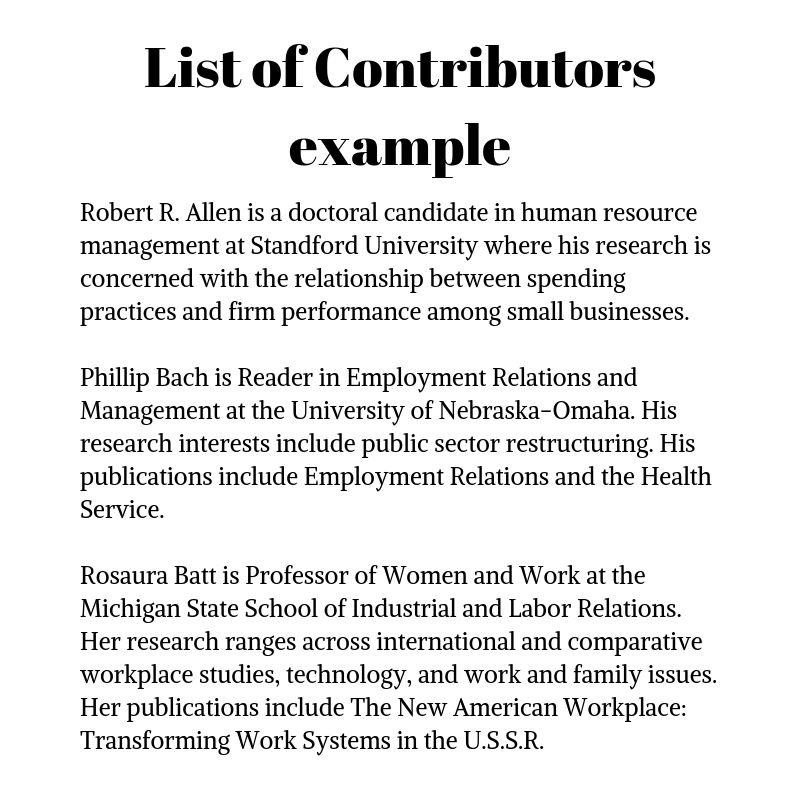
The List of Contributors includes relevant biographical information, like membership in certain organizations, current position demonstrating expertise in an area, academic affiliations or published works.
Contributors are listed in alphabetical order by last name but written in standard order. So Henry S. Pingleton is not written Pingleton, Henry S. but as Henry S. Pingleton and comes before Johnny Quimby and after Yori Oliver.
You might include editors, translators, publishers, agents, professional proofreaders, or professors in this section. Librarians and research assistants deserve their due as well. Don’t feel as if you have to include every publication each contributor wrote in this list. Instead, include the one or two most relevant to your book topic.
Assignment: Consider whether you need a formal List of Contributors or can get by with the more formal Acknowledgements.
Sarah and Nate Hunter become embroiled in more than they bargained for when they volunteer to help restore a crumbling church in Mirador, Chiapas. Unbeknownst to them, el Ejército Zapatista de Liberación Nacional (EZLN) has big plans to use Nate’s internet savvy in order to make public their War Against Oblivion. Then the unthinkable happens.
I have to say that Mirador by James A. Jennings was a great read. The Zapatistas (EZLN) have been in the news lately as they continue this struggle against oblivion begun in 1994. The pivotal events in the story occur just months before the Zapatista battle cry ¡YA BASTA! was heard on January 1, the day NAFTA was signed into effect.
The characters were well-developed and believable. The locations were described in exquisite detail. The political situation was explained in the introduction and then again in a historical note at the end, bringing the events up to the present.
What this book really needed, however, was a Mexican consultant for the Spanish phrases included in the book. These lacked the proper cadence and rhythm found in Mexican Spanish that just can’t be duplicated by a non-native speaker.
For example, although “Mi hijo” is grammatically correct, no one says that, mijo. It was to the point that I was reading the Spanish text as if a gringo were speaking, not a Mexican. There were also grammar errors. When speaking of the native people of the area, the correct term is “los indígenas” not “las indígenas” even though the word ends in the feminine “a.” Another incident was that a young man would NEVER use the informal “tú” tense when speaking to a woman he revered as a grandmother which occurred in the book. There were sentences that were totally incomprehensible in Spanish, as if the author tried to translate directly from English. “Ser grave” should have been “Se serio” and so on.
While I understand that the book was meant for English speakers, these glaring oversights detracted from my enjoyment of the story to some extent. Although to be authentic, most of the characters would have been speaking in one of the nearly 70 indigenous languages found in Mexico.
On the other hand, I took immense pleasure imagining life among the Zapatistas, something I probably will never experience. I was delighted to learn just a little more about el lek’il kuxlejal which roughly translates as buen vivir (living well) that is at the heart of the indigenous resistance movement in Mexico.
A bibliography can also be called works cited, resources, sources or references. Whichever name you choose, this is a list of books, articles, web sites or other sources that have been consulted in the creation of the book. A bibliography can be alphabetized or organized by theme, topic, or order of appearance.
A bibliography provides credibility to your non-fiction (or occasionally fiction) book. It shows that you didn’t just pull this information out of the air. It also gives readers a place to start if they want to do more research on their own.
An annotated bibliography gives additional publishing information about the article or book, a text description of the source, and how it is relevant to the book.
For each article, excerpt or book used in your book you should list the title, subtitle, author, publisher or website, year and page number. This information is listed in MLA or APA style. Whichever source you choose, you need to be consistent in using it for every entry. Print and online sources are written slightly differently.
Bibliography entries are typically formatted using a hanging indent. The first line of the citation is not indented, but if the entry continues to a second or even third line, those are indented. Formatting in this way makes the list easier to skim.
In MLA, a print book is cited:
Last name of the author, First name of the author. Book Title in Italics. City of the publisher: Publisher, Year Published. 100-102. Print.
If the book was accessed online citation is made this way:
Last name of the author, First name of the author. Book Title in Italics. City of the publisher: Publisher, Year Published. Website Title in Italics. Web. Day Month Year accessed.
If you are citing a website:
Last name of the author, First name of the author. “Article Title in Quotes.” Website Title in Italics. Publisher of Website, Day Month Year article was published. Web. Day Month Year accessed. <URL>.
In APA, a print book is cited:
Last name of author, F. M. (Year Published) Book Title in Italics. City, State: Publisher.
If the book was accessed online citation is made this way:
Last name of author, F. M. (Year Published) Book Title in Italics. Retrieved from http://
If you are citing a website:
Last name of author, F. M. (Year, Month Date Published) ArticleTitle in Italics. Retrieved from http://
If you need help formatting your MLA or APA citation for your bibliography, EasyBib has a tool to assist you that you can access here.
As an end-of-the-year bonus, both eBook versions are available for FREE on Amazon for the next few days (December 9 – 13). If you have time, I’d love it if you would leave a review on Amazon or Goodreads or drop me a line using the form below if you have suggestions on how I can make these two resources even better.
Despite regular policy and algorithm changes, Facebook is where it is at. You would be remiss if you didn’t take advantage of this free way to get some publicity.
Facebook allows you to Like and Comment on other pages using your author profile. Your news feed is separate from your personal page. You won’t be penalized by Facebook when you share your awesome book. Facebook also gives you a way to analyze post engagement, which you don’t have with your personal profile.
First, you need to have a personal Facebook account. Once you have that all setup, you’ll have the option Create at the top. Click on that.
You’ll be given two options, Business or Brand and Community or Public Figure. As an author, you are a public figure, so choose that one. If you offer writing services, then you might want to pick the Business profile.
Type in your name, or pen name, and Author as the category. Add a profile and cover photo. Use your author headshot as your profile picture. Design something interesting with Canva for your cover photo that includes the cover of your book.
Invite people to like your page. Check out Facebook’s tips. Take a look at the settings and add what you need to. You can connect your Instagram account and author website too.
So what should you post? Anything you want! Try for a good variety of types of posts, images, articles, links to book reviews, author interviews and so on. Remember, the idea is to provide content interesting enough for people to follow and engage with you. Then, throw in a self-promotion post every so often.
Facebook has a paid ads option which will be useful once you’ve established a good social media base, so keep that in mind for future marketing sessions.
Since these are the eBook versions, you’ll need your own notebook to respond to the journal prompts, of course, but I hope you will still find it soul-satisfying and empowering.
If your book is any kind of reference book, including cookbooks, you may wish to include an index. An index is an alphabetized list of terms which provides the page number or links to the words in the main text.
Unless you are indexing a proper noun, the index entry begins with a lower-case letter. If the entry is an acronym or abbreviation, spell it out in parentheses.
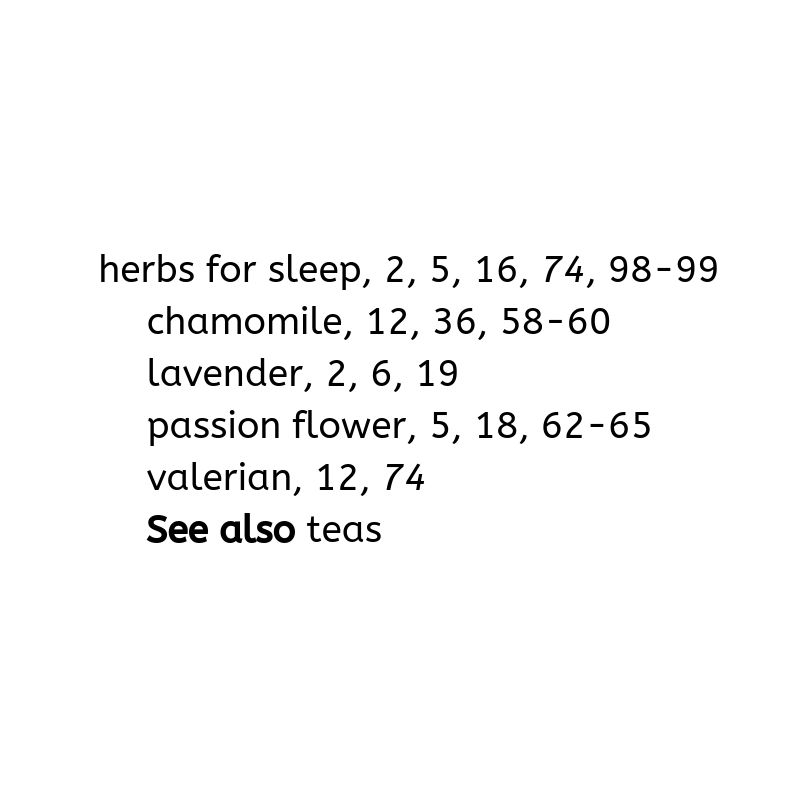
Try to use concrete nouns as index entries and be as specific as possible. For instance, in a book about herbal remedies, chamomile is a better entry than herbs with flowers.
When you want to cross-reference an entry with another use See also and list the alternate entry. Therefore after the entry chamomile, you might have See alsoherbs for sleep which lets the reader know that additional information about chamomile can be found under the entry herbs for sleep.
After the entry name, list the page numbers that the term can be found. Use a comma to separate the entry name and page numbers.Page numbers should be separated by commas and listed in numerical order. If you are including a page range, use a hyphen between the first and last page.
chamomile, 12, 36, 58-60. See also herbs for sleep
You can include tables and images in your indexing. To let the reader know that the page number refers to an image or table rather than text, then use italics or bold to differentiate the number. Make sure to include a note at the beginning of the index to the effect that “Page numbers in italics refer to images.”
If you have more specific terms under a general heading, indent the sub-categories.
Front and back matter do not need to be included in an index. Indexing is primarily for the main body of text in your book.
The index should be the very last writing you do for your book. You should wait to create an index until after you’ve done your final proofreading and editing. The reason for this is that changes in the text of your book will impact the index page numbers or links.
If you are not sure whether your book needs an index or not, then check other books similar to yours. Do any of them have indexes? Does it benefit the reader? How is it set up? What types of terms are included?
Also ask yourself if you have about 20 primary subjects worth indexing in your book or not. If you don’t, you probably don’t need an index at all.
The American Society for Indexing has an excellent resource about indexing that you can download here. You can find detailed instructions on how to create an index using Microsoft Word here. Pressbooks also gives instructions on how to set up an index with their platform here.