
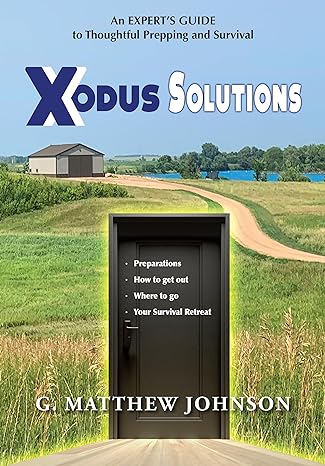
Xodus Solutions: An Expert’s Guide to Thoughtful Prepping and Survival By G. Matthew Johnson

Xodus Solutions, the book, is designed to complement the resources available at XodusSolutions.com and vice versa. The book’s first section focuses on the bug-out scenario, providing a host of possible solutions that most prepper books don’t cover when it’s time to get out of Dodge (or whatever urban location you happen to be in). As an example, the book considers evacuation methods involving caravans or aircraft leased or collectively owned by a group of individuals who share the common objective of leaving the area. The amount of organization and money these options entail makes them less feasible for the individual prepper or small family. 

Xodus Solutions outlines a strategy for executing these solutions, including the establishment of restricted-access fueling stations exclusively available to members and the commitment to coordinate flights from specific urban regions, also reserved for members. Readers are urged to participate in a website survey for additional details. While considerable research has gone into formulating these secure and orderly bug-out solutions, they do not address the unpredictability of human behavior, which frequently leads to frenzied scrambles and chaos when confronting life-or-death situations, even when there is a “plan.”

The following sections run through the estimates of how much food you might need, what tools and supplies would be helpful to have on hand, and some energy options. Again, I found the information to be on the upper scale of “survival options,” with more of a focus on hoarding rather than developing skills for survival after a catastrophic event. For instance, you certainly can rent fallow farmland and build a shelter to store your goods, but if the world order changes, that farmer will need that farmland to produce (as will you), and your tin shack will just be in the way.

The last section focused on nuclear bombs. While fascinating reading, it’s not something that you can effectively prepare for. Any supplies you have stored in a nuclear blast zone will be contaminated by radiation and unsafe to use. 

Overall, I found Xodus Solutions to be interesting reading. However, in my opinion, the book is primarily tailored to preppers who seek to minimize inconvenience rather than individuals like myself who are already living off-grid or for those who recognize that in TEOTWAWKI scenarios, a more fundamental survival skill set is required beyond what this book encompasses. 

I received an ARC from Reedsy Discovery to review this book. You can read my review HERE.

Todd by Adam J. Nicolai

One day, everyone in Alan’s life is gone. Everyone in Alan’s neighborhood is gone. Everyone in Alan’s state is gone. Everyone except Alan and his 8-year-old son Todd. Alan, an unemployed would-be entrepreneur suffering from depression, is not the man his son needs him to be in this TEOTWAWKI (The End Of The World As You Know It) scenario. 

Alan has not stockpiled for a doomsday event. He has not learned basic survival skills. He makes mistake after mistake as he struggles to keep himself and his son alive. Then he spots the blue blur and the approaching asteroid. 

This is the end-of-the-world survival book to end all books. The hero in our story isn’t a former special-ops military genus. Nor is he a self-sufficient hermit already prepping to the hilt. No, our guy is a loser from the suburbs, with no survival skills whatsoever with an 8-year-old boy tagging along.

I absolutely loved this book. I mean, what would you do if your toilet stopped working? Would you go about constructing an outhouse or start pooping in the neighbor’s living room? What about when your food supplies became covered in deadly blue moss? What would you do then? With winter approaching, would you stay in Minnesota or try to head south? How far south? Is Iowa far enough? With the power out, would you know enough to start a fire to cook food and stay warm? Would you know how to ventilate the room or to move the blanket far enough away so that it doesn’t catch fire? If you went on the road, what would you take and what would you leave behind? What about those blurs? How would you handle injuries? Do you know how to dress a wound?

If you want an amazing SHTF read with a bit of science fiction thrown in to lessen the predictability, then Todd by Adam J. Nicolai is the book for you!

Survival Tips, Tricks and Traps by Wanda Priday and William Priday

I’ve read dozens of prepper books over the years and found most to belong to the tin foil hat club. That is to say, the authors expect you to subscribe to their conspiracy theories which they go to great lengths to explain before they knuckle down and get to the practical stuff. I was delighted to find that Survival Tips, Tricks and Traps by Wanda Priday and William Priday was not that sort of book. 

Instead, it was chocked full of useful tidbits that you can apply to emergency situations, whatever that may be. In fact, the book is so practical that the last few pages are “firestarter” pages making it the perfect book to tote around on your hunting or camping expeditions, as well as keeping a second copy in your bug-out-bag.  

There are nine chapters that cover fire, water, tools, weapons, navigation and traps. Each chapter gives sensible tips to help you best survive whatever the situation you find yourself in, from a sudden WROL (without rule of law) scenario to a plane crash. 

I totally agree with the thought the authors present that your skills are what will keep you alive in any SHTF situation, not the stockpile of shiny prepper items you have stockpiled in your bunker. To that end, this book isn’t an all inclusive survival book, but tips meant to increase the chances of your survival. It includes some checklists, a few tool suggestions, ways to practice your prepper skills in everyday life, and reams of good advice.

As I mentioned, I’ve read a plethora of prepper books, and am passionate about the practical value of the plant life that surrounds me. However, there were some things mentioned in this book that were completely new to me including the phenomenon of spalting rocks, the versatility of potassium permanganate, and the nutritional value of earthworms among others.

My favorite chapter, if I had to pick one, focused on tools. Did you know you could open a can without a knife or can opener? Or that your walking stick should be taller than you for safety reasons? How about the many uses of inner tubes, towels, condoms, tampons and cigarettes in a survival situation? 

The final chapter on traps is extensive. It details several types of animal traps specific to the type of animal you are hunting and the materials you have on hand, complete with illustrations. I may never need to use that information, but should I find myself in a situation where I do, I’ll certainly be glad I picked up a copy of Survival Tips, Tricks and Traps by Wanda Priday and William Priday.

I received an ARC from Reedsy Discovery. You can read my review here.