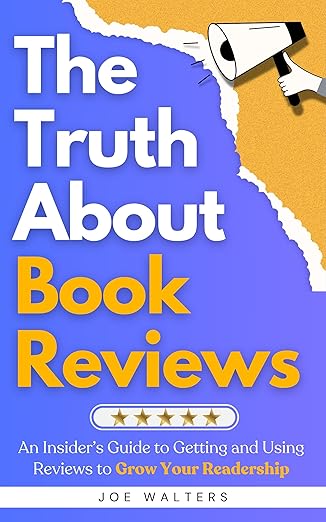
The Truth About Book Reviews: An Insider’s Guide to Getting and Using Reviews to Grow Your Readership by Joe Walters

The Truth About Book Reviews: An Insider’s Guide to Getting and Using Reviews to Grow Your Readership by Joe Walters is a practical, detailed guide for authors who are serious about reaching readers through the power of reviews. For many introverted writers, the idea of asking for reviews can feel intimidating or even impossible. Walters breaks this process down into manageable, actionable steps, showing that obtaining meaningful feedback isn’t as mysterious or unattainable as it seems.

The book clarifies the many different types of reviews, including editorial, media and trade, and customer reviews. It explains their relative importance and how each serves a unique role in an author’s marketing strategy. Walters also discusses how to find and approach reviewers, how to craft effective pitches, and how to make the most of every review once you have it. His insider experience as editor-in-chief of Independent Book Review provides a behind-the-scenes look at what makes a pitch stand out.

While I can’t say I agreed with every point, I found the information genuinely useful. The research required to find the right reviewers can be daunting, and at times, the book reads like a subtle promotion for Walters’ own services. Still, there’s undeniable value in the insight he provides. The inclusion of real email samples, organizational tools, and an excellent to-do list at the end makes the guide not just informative but actionable.

Ironically but effectively, Walters demonstrates his own strategy by reaching out to reviewers like ME to ask for reviews. The fact that I’m now reviewing his book proves his method works. Overall, The Truth About Book Reviews is an honest, accessible, and practical resource that demystifies one of the hardest parts of being an author: getting your work noticed.
The Great Gatsby by F. Scott Fitzgerald

In the spirit of Banned Book Week, I’ve chosen to review a frequently banned book. The Great Gatsby has been challenged and removed from classrooms and library shelves at various times for reasons including sexual references, “profane” language, and depictions of adultery and alcohol use. The novel appears on lists of frequently challenged classics compiled by the American Library Association and related organizations.

This book is like a small, perfectly cut shard of glass: elegant surfaces, sharp edges, and a surprising sting when you look closely. I teach this novel on the platform I work at currently, and the classroom reactions I get have reminded me how much reading is a conversation between text and reader, and how cultural background changes which parts of the book land hard and which parts drift by.

The novel’s canny control of point-of-view, a judgmental Nick Carraway telling us about Gatsby’s dream and the hollowness of old money, is both its strength and, for me, its limitation. Nick’s moralizing gaze gives the book a coherent voice, but it also narrows the novel’s humanity. We almost never see the world except as Nick chooses to frame it. That skewed viewpoint is why the ending, the plot twist, and the moral fallout still hit me every time. The book gives us a climax that feels inevitable and then painfully unresolved.

As a whole, the book can feel thin on action. Much of the “plot” is social maneuvering, parties, and revelations delivered via rumor or later recollection. If you’re the sort of reader who wants kinetic scenes and sustained drama, Gatsby can test your patience. I’m not sure I would have enjoyed it as a teenager. Its pleasures are often retrospective and full of world-weary reflection, things teens don’t always value. My current student, however, is unusually enthusiastic about Gatsby’s romance and tragedy, so who’s to say?

One of my continuing frustrations with the novel is how little we learn about the women who live at its center, Daisy, Jordan, and Myrtle, and even about minor figures like the Finn (the servant) who occupy real positions in the social web. We get Daisy largely as a projection (idealized, then revealed to be small), Jordan as a sketch of modern cynicism, and Myrtle through others’ outrage. Even after reading through the entire book several times, I’m left with questions such as: What were Daisy’s real options in her social world? Why did Jordan cheat and lie, or did she? What did the Finn think about her place in the household and Nick himself? What actually mattered to Myrtle beyond her brief, tragic grasp at glamour? 

In general, I find the sharp, sudden scenes depicting violence to be abrupt and unexpected. The incidents of overt racism and classism are often hard to read from the world’s current position. Despite some definite cringe, I keep teaching The Great Gatsby because it’s compact, richly written, and full of teachable techniques: voice, symbolism (the green light, the Valley of Ashes), and the way an unreliable narrator shapes what a story becomes. It generates excellent class discussions about the American Dream, class, and social performance. But I also teach it with a critique. We read it as a masterpiece and as a text with blind spots, including limited female perspective, a narrow moral lens, and an emphasis on spectacle over sustained action.

If you love it, you’ll find it elegant and quietly devastating. If you find it unsatisfying (as I often do), the book still rewards close reading, especially if you hold a pencil to its margins and ask the questions it leaves unanswered.

2025 Reading Challenge

I really enjoyed my reading challenge last year. I think it made a difference that I didn’t try and pick a certain category for each month, but had options to choose from. So yep, I’m going to do a reading challenge this year.

I’m starting with two categories that I did not complete in prior challenges, a book on my shelf already, and a hardcover book. I think those will be easy to incorporate in the reads for the year.

I found this 2025 reading challenge list and since it seems like it covers a broad spectrum (and has 16 categories), I’m going to use it myself.

What are you reading?

Reading Roundup 2021

January

Anxious People by Fredrik Backman was a good mystery read with a not-quite believable ending.

February

I read How to Write a Book That Doesn’t Suck and Will Actually Sell: Your No B.S. Guide to Learning How to Write a Nonfiction Book by Michael Rogan for further research on refining my writing.

March

Travels with Grace by Erma Note highlights the cultural delights of Mexico City.

April

An interesting paranormal romance, Saving Cassie by L.A. Remenicky was a little outside my usual picks, but that’s the point of the challenge right?

May

I chose Job by Ben Avery and illustrated by Jeff Slemons, as my graphic novel for the year.

June

Middle-aged female nomad on the loose in Tales of a Female Nomad: Living at Large in the World by Rita Golden Gelman. You’ll not want to miss her adventures!

July

Immigrant Secrets: The Search for my Grandparents by John Mancini was a lovely tale of one man’s family history quest that mixed speculative fiction with fact.

August

I belong to an online book club and This is How it Always Is by Laurie Frankel was the selection of the month. What a discussion we had about this book about a transgender child coming of age. A thought-provoking story!

September

A random free book download led to an amazing new thriller series with Probably Dead by Ed Church.

October

November

I read several books this year about health issues, but the one that stood out the most was The Seven Graces of Ageless Aging: How to Die Young as Late in Life as Possible by Jason Elias.

December

Todd by Adam J. Nicolai was my survivalist/science-fiction pick for the year.

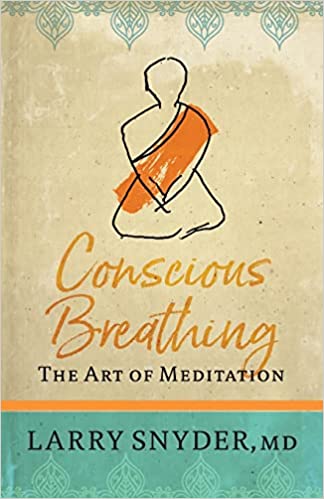
conscious Breathing: The Art of Meditation by Larry Snyder, MD

Having read The Four Agreements by Don Miguel Ruiz and The Power of Now by Eckhart Tolle, I felt I could more than handle Conscious Breathing: The Art of Meditation by Larry Snyder, MD. I was pleasantly surprised to discover that this little gem was not only a more accessible guide to meditation but also that it addressed the number one obstacle to mindful living, addiction.

My favorite chapter was entitled “Anxiety, Addiction, and Acceptance.” It begins by defining addiction and demonstrating how it contributes to anxiety. When we accept that addiction and anxiety are part of human existence, we can find ways to mediate their effects on our well-being. The author gives the example of two individuals injured in an auto accident. One seeks retaliation against the other driver through a lawsuit. The other concentrates on physical therapy and recovers sooner. What we focus on influences our future happiness. 

The author isn’t judgemental, merely suggestive as he discusses meditation practices. All things are temporary, including our thoughts and emotions. Conscious breathing through meditation allows us to let it all go. The book is short enough that it can be read several times. After all, meditation isn’t something that can be mastered but rather practiced day in and day out. 

On the other hand, just as substance addition is a relapsing neurobiological disease, surrendering our belief in control is something we need to do repeatedly, much like Sisyphus rolling his boulder up the mountain for eternity. Along the same lines, Sisyphus had options. It makes you wonder if he railed against his fate or enjoyed the climb. Considering he tried to outwit death several times, which resulted in his punishment, I imagine he spent eternity looking for another opportunity to control the situation, his addiction, as it were.

Anyway, just as meditation isn’t for everyone, this book might not appeal to all readers. The essays are short and separated by nice, if not exceptionally inspiring, photographs. So many things are out of our control, and not everyone is ready to accept that; thus, the act of “letting go” encouraged in the book isn’t obtainable for some yet. 

I received an ARC from Reedsy Discovery. You can find my review here.

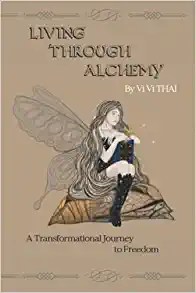
Living Through Alchemy: A transformational journey to freedom by Vi Vi Thai

Vi Vi Thai creatively illustrates her inner transformation in Living Through Alchemy: A transformational journey to freedom by Vi Vi Thai. In this book, the author shared her life from her birth in Vietnam through her Master’s degree in Bio-Medical Engineering at Cornell University as the backdrop to her personal transformation. Her real growth occurred after she started a new life in Canada as a van dweller. In addition to Vi Vi Thai’s personal story, the author includes journal prompts to aid the reader in their own transformation and a bonus chapter about her travel companion, Marco, the dog.  

This book might not be an effective medium for encouraging personal growth for individuals unfamiliar with tarot cards, which introduce each development period. For instance, chapter 4 began with card number 9 in the Rider-Waite tarot deck, the Hermit. There was a brief description of the card highlighting how to interpret it when it appears in a reading. Then the author talked about a period in her life that corresponded to this card, in this case, her return to Vietnam in shame resulting in social isolation. 

There were some misused phrases and terms resulting from the fact that the author’s first language is not English, but they were minor and did not detract from the understanding. The first few chapters are a bit repetitive. However, the author smoothes the storytelling out as the book progresses. 

There was a lot of information in the first chapter. In what is supposed to be an overview of alchemy, Thai discussed the definition of alchemy, the seven chakras, the caduceus, the eye of Horus and the Pineal gland, and the Hero’s Journey. This section might have been better focused on just the tarot cards and how they relate to the Hero’s Journey since there was little mention of the seven chakras, the caduceus, or the eye of Horus and the Pineal gland in the rest of the book. 

The transformational story Vi Vi Thai shares with the reader in Living Through Alchemy: A transformational journey to freedom was compelling. Marco’s story was sweet as well. It’s a great book to start the new year!

I received an ARC from Reedsy Discovery. You can read my review here.

Powerful You! Little memoirs of inspirational women by Anna Burgess

Powerful You! Little memoirs of inspirational women by Anna Burgess tells the abbreviated stories of five women and the author. It also includes a memorial to an elderly friend of the author, Raymond Farrell. Encouraging commentary is interspersed throughout the book, designed to inspire women confronting life’s obstacles.

It’s not a long or difficult read. The women’s stories are moving. These women overcame challenges that included homelessness, divorce, illness and death of a parent, thriving as a single mother, surviving cancer, and starting a nonprofit.

Although the author repeatedly reiterates that this book is for every woman, it seems as if the target audience was actually the author’s friends and family, rather than for public consumption. For this to be a coaching book, which I’m not convinced it was meant to be, questions after each story to help the reader reflect on her own life would have been good. As it was, the message was, “See these women! They overcame adversity, and so can you!” but without any clear direction on how someone could do that.

Several times, the author states that if just one woman is inspired, then her book will have been a success. I think she sells herself short. The book has the potential of helping thousands of women find direction, with a bit of work.

Each woman’s excerpt was interesting but no more than a few paragraphs except for the author. The author’s own story, while moving, needed some content editing. It seemed that she wrote in a stream of consciousness and then couldn’t bear to go back and edit out redundancies or irrelevant information. The final chapter dedicated to Raymond, the elderly gentleman, seemed out of place in this book geared toward women.

I noticed no grammar or spelling issues in the text, which made it a nice read. Anyone who enjoys reading about others’ life stories would enjoy this book. Those that are looking for help with their in-depth soul-searching processes will need to look elsewhere.

I received an ARC from Reedsy Discovery. You can find my review here.

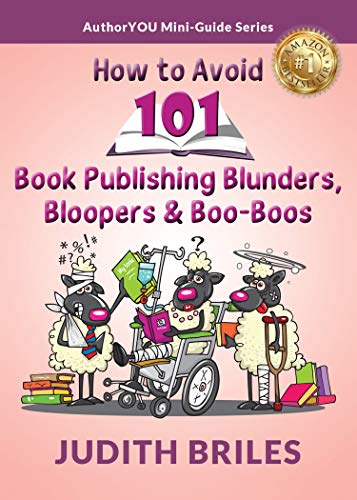
How to Avoid 101 Book Publishing Blunders, Bloopers & Boo-Boos: how to successful publish a book by Judith Briles

When I picked up How to Avoid 101 Book Publishing Blunders, Bloopers & Boo-Boos: how to successful publish a book by Judith Briles, I decided to ignore the blooper in the title (successfully) in the hopes of some useful tidbits. I did indeed get some useful tidbits, however not 101, which was disappointing.

Some sections were geared towards authors who have managed to snag a traditional book publishing deal. Since I have not, although I haven’t given up hope of someday, the information about reading the fine print, making sure you keep your rights to republication, and getting the best deal of the book publishing company, didn’t apply to me. 

I did learn about the Amazon Advantage program. However, when I did more research, I discovered that this publishing platform is closed to new publishers (such as myself). Amazon has given no date for reopening, unfortunately. Since I can’t access the Amazon Advantage program, the chapters on finding a decent printer weren’t useful either. To publish on Amazon, currently I need to use Amazon’s print on demand service. 

Another Amazon program that has expired but is included in the blooper book is the Matchbook program, where you could offer a digital copy of your print book for a reduced price or free. This nifty feature was taken out of circulation in October of 2019. Phooey. 

Not everything presented was obsolete or irreverent though. I really liked the idea of creating a tag line that expresses what my books (or me) do to benefit the reader. I also appreciated the suggestion to add a copyright watermark to images that I have created and share on social media. 

Overall, I was disappointed with the amount of useful information I found in this book that had such high ratings on Amazon. Some chapters seemed redundant, others weren’t useful since the feature wasn’t available anymore, and others were irrelevant to my particular writing situation. If you are a first-time author looking for the tricks of the trade, I can’t say that I recommend How to Avoid 101 Book Publishing Blunders, Bloopers & Boo-Boos: how to successful publish a book by Judith Briles.

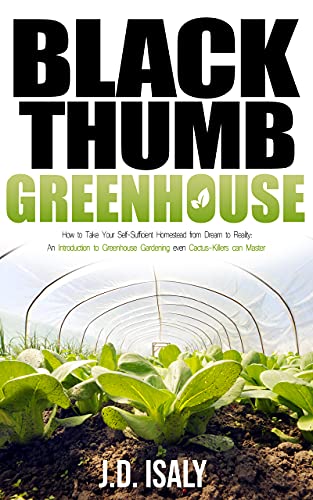
Black Thumb Greenhouse: How to Take Your Self-Sufficient Homestead from Dream to Reality: An Introduction to Greenhouse Gardening even Cactus-Killers can Master by J.D. Isaly

J.D. Isaly has done a magnificent job of describing greenhouse options, detailing necessary components to successful greenhouse gardening, and discussing plants that do well in greenhouse conditions. The information about the history of the greenhouse and the benefits of utilizing a greenhouse were well-researched and clearly presented. 

The author shared his extensive knowledge about greenhouse construction and its upkeep. Since I have been dithering back and forth about whether I wanted to invest in a greenhouse to extend my growing season, I read this book eagerly. After I finished, I decided that a greenhouse is not in the near future because of the growing conditions in my area based on the information Isaly provided. Thus, you can see that the thorough treatment of the topic would be extremely beneficial to anyone considering or ready to take the leap into greenhouse gardening.

I especially liked how the author talked about how gardening can provide physical and mental benefits to the gardener. Anyone who putters around in the soil can attest to the contentment felt out digging in the dirt. Of course, the physical activity involved in gardening is beneficial to staying in shape as is the option of eating non-GMO, organic produce. Interspersed between the chapters were short, fascinating trivia tidbits about plants under the heading “Did you know?”

The only thing I felt would have added to this informative text were drawings. For instance, when the author was explaining the relative merit of different types of greenhouses, I would have liked to have had a picture to help me understand the descriptions better. Or when describing the drainage system, I didn’t really have a clear idea of what the v-shaped flood floor consisted of. An illustration would have been helpful here too.

So if you are considering setting a greenhouse to augment your food production, then Black Thumb Greenhouse: How to Take Your Self-Sufficient Homestead from Dream to Reality: An Introduction to Greenhouse Gardening even Cactus-Killers can Master by J.D. Isaly is the perfect book to help you begin.

I received an ARC from Reedsy Discovery. You can read my review here.