Blog to Book Project — Copyright

Copyright page

Copyright is “the exclusive legal right to reproduce, publish, sell, or distribute the matter and form of something” according to Merriam Webster. You may reference facts, sources or other generally known bits of information in your Blog to Book Project as long as you give credit where credit is due. This information would be included in your Appendix (remember we talked about that?)

Once your book is published, you own the copyright to everything in the book. That means you can:

  • Reproduce the work in a book or other form, like an ecourse.
  • Benefit financially from proceeds of the work.
  • Create works that build upon your work (translations, sequels, adaptations, etc).
  • Display or perform your work (plays, Youtube videos, podcasts).

You own those rights. If anyone else uses your content for his or her own purposes, then you have the right to file a copyright infringement claim.

So say that your book, Everything You Need to Know to Turn Your Blog Posts into a Book, appears on Udemy as a course. The course uses your book’s instructions and even direct quotes. Only you didn’t make that course and someone else is receiving money by presenting your hard work in a different format. COPYRIGHT INFRINGEMENT! In this case, you’ll contact the course creator and Udemy, since they are hosting the course, and insist that it be removed.

Your copyright page comes right after the title page and just before the table of contents. The copyright expires between 50 and 70 years after an author’s death, depending on the country, and the work then becomes public domain, so it can be distributed by anyone.

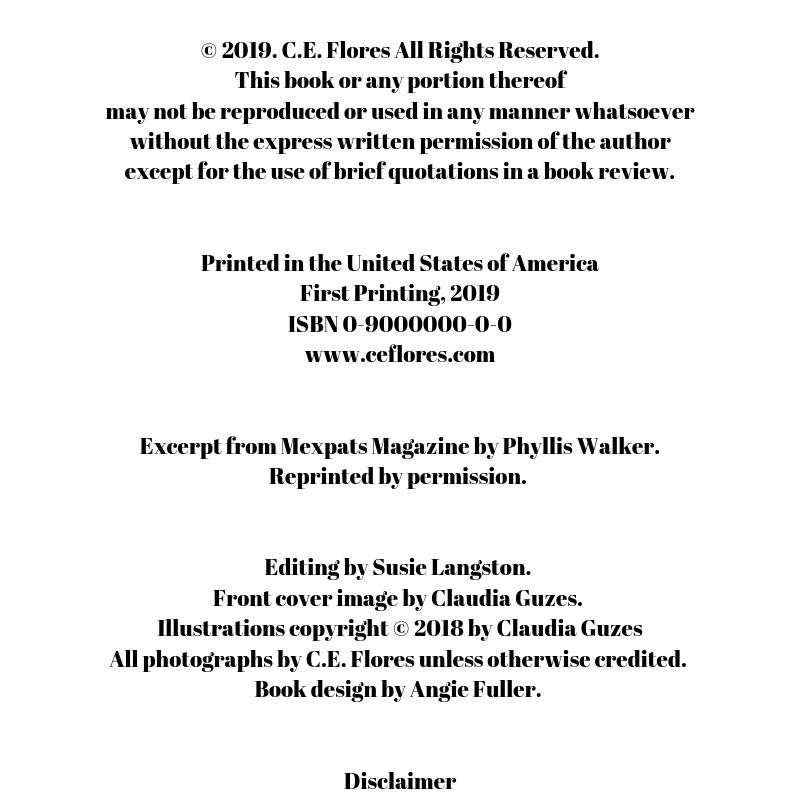
Your copyright page should include:

  • © symbol or “copyright.”
  • Publication year
  • Your name
  • All Rights Reserved.
  • Copyright notice
  • Book editions
  • ISBN Number (We’ll discuss this in more detail on another day.)
  • Your website
  • Permissions Notice if you use copyrighted information in your book.
  • Credits to the book (cover designer, editor)
  • Disclaimer (We’ll talk about disclaimers tomorrow.)

Assignment:

Create the rough draft of your copyright page.

Blog to Book Project — Blog Posts vs. Book Chapters

What is the difference between a blog post and a book chapter?

There are some basic differences between the two. However, what you’ll find is that with a little tweaking, you’ll be able to create chapters for your book from your blog posts.

Sections of a Blog Post

  • Headline
  • Hook ‘em stellar introduction
  • Tell your story
  • Add some bullet points
  • Link to credible sites that support the details
  • Add eye-catching images
  • End with a call-to-action (respond in the comments, share, buy)

Chapter of a Book

  • Title
  • Interest grabbing introduction
  • Tell your story
  • Conclusion
  • Pictures

As an example, let’s compare the structure of a blog post that I turned into a chapter in a book.

The blog post had the title: Women in Mexican History–Josefa Ortiz de Dominguez. When it became a chapter of A Woman’s Survival Guide to Holidays in Mexico, the title of this chapter became: Josefa Ortiz de Dominguez.

There were two images in the blog post to break up the text. These were rearranged in the book chapter so that one was at the beginning and one was at the end of the chapter. Doing so helped with the page formatting so that there wasn’t a dangling sentence on one page all by itself.

There were a number of hyperlinks to back up the historical information as it pertained to Josefa ’s story. Those hyperlinks were moved to a section entitled Josefa Ortiz de Dominguez in the Appendix for the book. (We talked about the Appendix yesterday remember?)

The blog post ended with the call to action for readers to buy the book A Woman’s Survival Guide to Holidays in Mexico. The book does not have a call to action at the end and the chapter concludes at that point.

In this example, there weren’t any drastic writing changes in the conversion from post to chapter. Sometimes more information will need to be added to the chapter if there are gaps in information. This might happen if you have written about a topic on your blog and link to a prior post rather than go through the whole story again. Sometimes information should be removed from the chapter if it isn’t relevent to the book topic.

This post didn’t have any bullet points either. For the most part, my chapters don’t have bullet points since they tend to mess with the formatting in a book . If they aren’t just so, you can have more white space than you want. However, there’s nothing wrong with bullet points appropriately positioned in a book chapter.

Theme

Although it seems relatively straight forward converting your blog posts into chapters, you need to keep in mind that the book you are creating should not just be a collection of your blog posts.

Books have themes that tie the chapters together. Your Blog to Book Project should have a dedicated theme.

To illustrate this point, I wrote a series of blog posts about being a Prepper and living off-grid in central Mexico. I compiled those 30 odd posts into a book for Preppers considering Mexico as a bug-out location. I ONLY included posts related to our life as Preppers. I did not include any posts about me being an ESL teacher, our animals, or building our house. Those are topics I am in the process of compiling into separate books.

How to Choose a Theme

As you blog, you should have been organizing your posts by category or tag. Checking which categories have the most reader interaction would be a good way to pick a topic for your blog to book project.

It often helps to think of your future blog to book project as a proposed solution to a specific question. In the book A to Z Reasons Why La Yacata is the Place to Be in Any Disaster: A Prepper’s Guide to Mexico, the question is whether Mexico would be a good location WTSHTF (when the shit hits the fan) or not. The book addresses natural, political and personal disaster situations from the perspective of a long-time resident of Mexico. By the end of the book readers should have an idea about the most important drawbacks or benefits to living in Mexico and if there are ways to alleviate the danger of these disaster potentials.

Organization

You should also consider the structure of your book. In the above-mentioned book, the chapters were listed alphabetically. In another book, A Woman’s Survival Guide to Holidays in Mexico, the chapters were organized chronologically from January to December. The organizational strategy that you choose should be easy to follow and make sense for your topic. Chapters are very rarely organized by the date they appeared on your blog.

Your assignment for today is to choose a topic for your Blog to Book Project and decide how to organize the posts that will be included.
Blog to Book Project — Appendix

Today, we are starting with the end of the book–the Appendix.

So what is the appendix and why do you need one in your blog to book adventure?

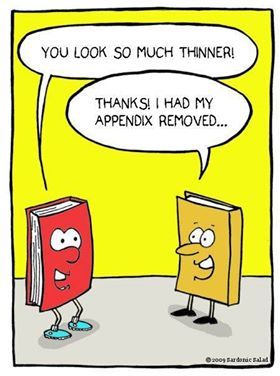
Yes, yes, I know it’s a part of the human body that spontaneously combusts and causes life-threatening infection or even death. But in the writing world, an “Appendix is defined as the section at the end of a book that gives additional information on the topic explored in the contents of the text.

Do you need an appendix? Not necessarily. However, if you need to explain something in addition to the text of the book, this is where you would put it. This is also where you would list other books related to the subject your blog to book project is about, references and citations.

Since your blog to book project is non-fiction, having an appendix that lists this information adds credibility to your story. For instance, if I’m writing about how I do not have internet access at my home in central Mexico, I might include a summary and link to a study done by the Mexican government that states that in the area I live in only 1 in 8 people have internet access. The citation says “See, people, I”m not making it up!” and my story is, therefore, more believable.

So biographies, autobiographies, memoirs, and research-based books all would do well to have an appendix backing up the statements in the book. You could also include full copies of letters you excerpt in your blog to book project since including the full letter in the text might be uneccessary. Or maybe something scientific needs further explaining, so you include a graph or diagram in the appendix. If it adds to the credibility or understandability of your story, then it should be in the appendix.

You can actually have more than one appendix section. One section might contain a bibliography of works cited. Another might cite the sources for all the quotes you used in images throughout your book. A third part might list background information about people that appear in your story. In this case, each separate appendix might be titled Appendix A, Appendix B, Appendix C.

Your assignment for today is to take a look at the information you want to include in your blog to book project and decide what will be in the appendix. Then make it so.

A Woman’s Survival Guide to Mexican Healthcare by C.E. Flores

healthcare cover

A Woman’s Survival Guide to Mexican Healthcare is finally ready for release. The book covers the basics of the Mexican national healthcare system as it stands now, the reality of sexual assault, femicide, and abuse in Mexico, the role of the traditional curandera, and herbal remedies as alternative healing practices. Women living in all parts of Mexico (and Guatemala) candidly shared their health and wellness experiences so that other women will be better informed.

It is my hope that this book in some way empowers women who have moved to Mexico to have some measure control of their own healing. You can get it free at Amazon for the next few days.

Que est(Be well).jpg

Free Travel Book In Honor of Virtual Vacation Day

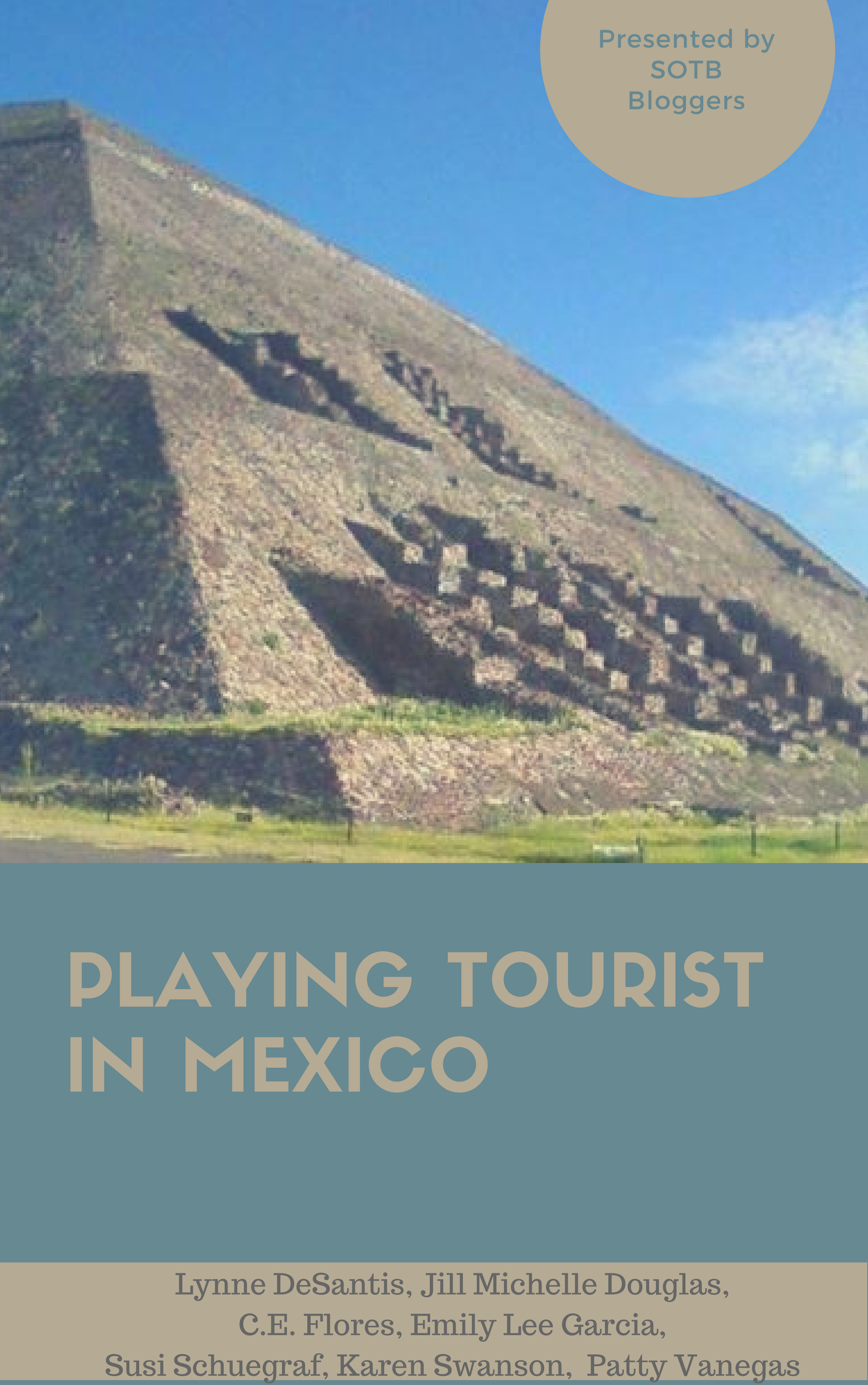
Surviving Mexico and the SOTB Bloggers group are pleased to present you with your passport to your Virtual Vacation in Mexico in honor of Virtual Vacation Day!

Playing Tourist is a compilation of 45 travel adventures across Mexico, from the tiniest towns to the sprawling metropolis of Mexico City.

Get your FREE copy herhttps://survivingmexico.files.wordpress.com/2019/04/playing-tourist-in-mexico-1555546160.pdfe!

We Won’t Forget You… Mr. McGillicuddy by Ira L. White

Did you ever consider the implications of what you blog about?  Perhaps you should! Robert McGillicuddy has his hands full caring for an elderly father, pregnant daughter, teenage granddaughter and BP, his affectionate dog.  In the moments he isn’t trying to juggle all his obligations, he writes a blog with a steadily growing readership.  He is blissfully unaware that it’s been flagged by the government as subversive.  Life is about to change drastically for the McGillicuddy family.

I enjoyed reading about the ordinary lives of the characters and Robert’s blog posts in We Won’t Forget You… Mr. McGillicuddy by Ira L. White.  Robert’s father’s daily struggles were so typical of many elderly today.  His daughter’s efforts to provide for her children and the failure of the system for those who most need it also have a strong basis in reality.  It’s no wonder Robert becomes vocal about the government’s shortcomings in his blog posts.

I least liked that the book ended.  I’m hoping there is a sequel in the works.  How do Robert and his family manage?  They aren’t in the least prepared for the situation they find themselves in.  They certainly aren’t Preppers.  What will they do?  Perhaps they should come to La Yacata! 

We Won’t Forget You… Mr. McGillicuddy by Ira L. White will be an enjoyable read for most everyone because of its commentary on everyday struggles in the land of the free and the brave.  It might even inspire its readers to create their own Prepper communities in preparation for possible societal disaster in the near future.  However, those that prefer to keep their heads in the sand about current events won’t enjoy this book.

3 star

I think there needs to be a bit more development in some of the main characters.  Gil and Robert have fully fleshed out characters down to the minutest detail but Ruby and Sapphire seem very one-dimensional.  I would also like to see more of Robert’s blog posts.  Maybe some of the aside chapters, those sections that had nothing to do with the McGillicuddy family, could be presented as blog posts.  And, of course, I want to know what happens next!

This book was an OnlineBookClub.org Book of the Day.  Read about it here.

Master Your Money Ultimate Bundle

Ultimate Bundles is offering another one of their amazing collections. If you aren’t familiar with Ultimate Bundles you are in for a treat! What they do is collect ebooks, workbooks, eCourses and videos into one bundle and offer it at a deeply discounted price!

What's inside the Master Your Money Super Bundle

The Master Your Money Ultimate Bundle contains  13 eBooks, 9 printables & workbooks, 12 eCourses, and 11 videos all designed to help you improve your finances with a total value of $1206.41. BUT………you pay only $37 for the full bundle

Topics include:

  • Better Budgeting
  • Defeat Debt
  • Family Finances
  • Increasing Your Income
  • Managing Money
  • Money Mindset
  • Saving Money

Don’t wait too long! This bundle is only available from Wednesday, March 27  to Monday, April 1, 2019.

Master Your Money Super Bundle 2019 - Learn More

Immediacy: Our Ways of Coping in Everyday Life by Fred Emil Katz

“They could not believe it. They could not believe they would be stripped of their citizenship until it happened. They could not believe their houses of worship would be destroyed unti

How do ordinary men and women find themselves complacently or even passionately supporting mass murder?  How can people transcend their immediate personal suffering yet succumb years later?  How can society prevent such atrocities such as the Holocaust or the Spanish Inquisition from reoccurring? What causes people to willingly sacrifice their lives for a national or religious rationale? How can these things be measured empirically and studied? Author Fred Emil Katz discusses these questions and more in Immediacy: Our Ways of Coping in Everyday Life.

The topic presented is complex.  Immediacy: Our Ways of Coping in Everyday Life is a series of essays and articles written by the author during his distinguished career as a sociologist that have been compiled and updated. The book has 5 principal sections, each with an introduction that explains how these chapters relate to the idea of immediacy. I found these introductory chapters to be extremely helpful in my understanding of the material.

It may seem to some that society as a whole has evolved beyond the incidents discussed in this book, but has it?  (List of genocides by death toll) A call for national unity in an effort to make the country great again which becomes the justification for national purging of undesired and unassimilated residents, never mind the cost to human lives, sounds eerily familiar.  Although Katz has more questions than answers for us, at least he is presenting this topic for our consideration and if we were wise, we would ponder them carefully.

I especially found the chapter on societal denial to be eye-opening.  Sometimes, humanity turns a blind eye.  Sometimes we just can’t see.

“They could not believe it. They could not believe they would be stripped of their citizenship until it happened. They could not believe their houses of worship would be destroyed unti

The examples the author uses to illustrate each aspect of immediacy are well-known.  He uses some unorthodox punctuation, dashes rather than commas or parentheses, but it did not detract from the overall readability of the text.

four star

While I believe that the message is one that everyone should be made aware of, I’m not sure that everyone would benefit from reading this book.  Its tone was scholarly even when discussing the fate of the author’s own parents and elder brother.  Sociology as an applied science is still in its infancy.  We just may not be able to think of our immediacies as something we can change.  

“They could not believe it. They could not believe they would be stripped of their citizenship until it happened. They could not believe their houses of worship would be destroyed unti

This book was an OnlineBookClub.org Book of the Day.

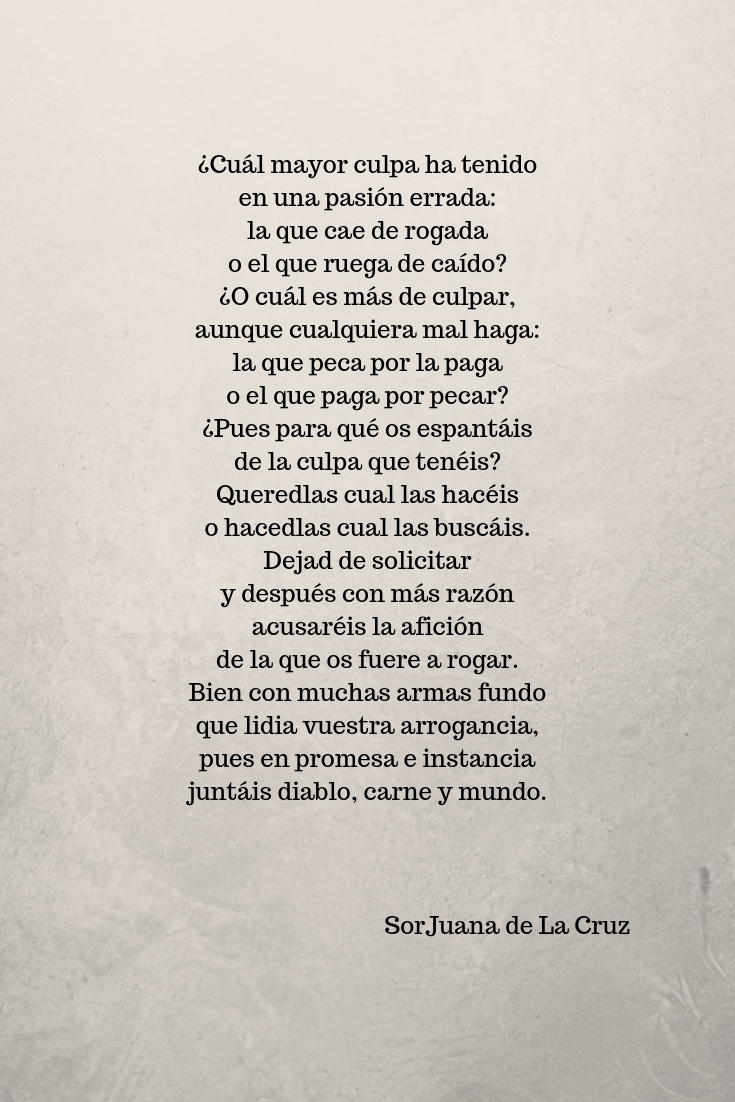
Sor Juana de La Cruz

In honor of Poetry Day, I’d like to share a little information about Mexican poet Sor Juana de la Cruz.

Juana Inés de Asbaje y Ramírez de Santillana was born on November 12, 1648 near Mexico City in San Miguel Nepantla. Her mother,  Isabel Ramírez de Santillana de Cantillana, belonged to the Criolla section of the Mexican population. Her father was a Spanish Captain by the name of Pedro Manuel de Asbaje y Machuca.

She was raised on her grandfather’s hacienda in Amecameca. She was somewhat of a prodigy if the accounts are to be believed. Educating females was strictly forbidden however somehow Juana was able to write in Latin by age three, do account by age five and composed a poem on the Eucharist at age eight.

Her astonishing accomplishments didn’t stop there. As a teenager, she was versed in Greek philosophy, teaching Latin to younger children and fluent enough in Nahuatl, which she learned fom the slaves on the hacienda, to write poems in that language.

In her teens unable to attend the university because of her gender, she became a lady-in-waiting at the viceroy’s court. The Vicereine Leonor Carreto became her patroness. She declined several offers of marriage and instead entered the St. Joseph Monastery in 1667 as a postulant. She took her vows in 1669 at a different monastery, el Convento de San Jerónimo, because she desired “Vivir sola… no tener ocupación alguna obligatoria que embarazase la libertad de mi estudio, ni rumor de comunidad que impidiese el sosegado silencio de mis libros”(to have no fixed occupation which might curtail my freedom to study).

As penance for her traitorous words and actions as a radical feminist who believed in educational opportunities for women, she was forced to do penance which included giving up her books, musical and scientific instruments. Sor Juana contracted the plague during her ministrations to other nuns and died on April 17, 1695.

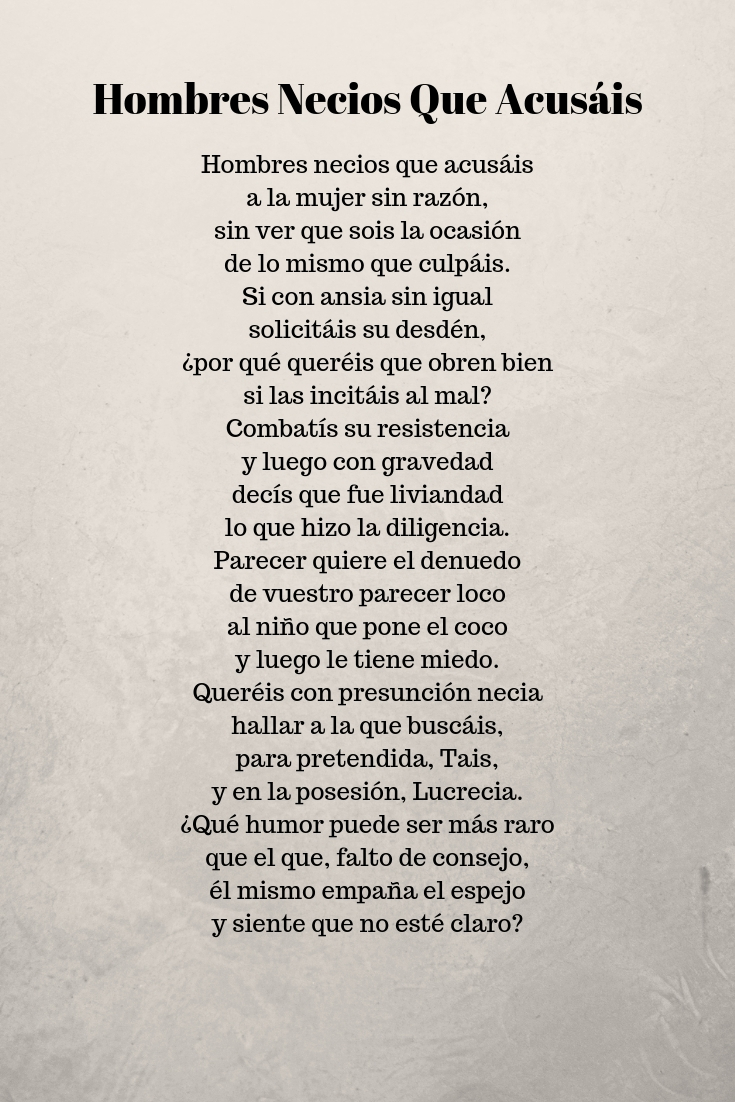
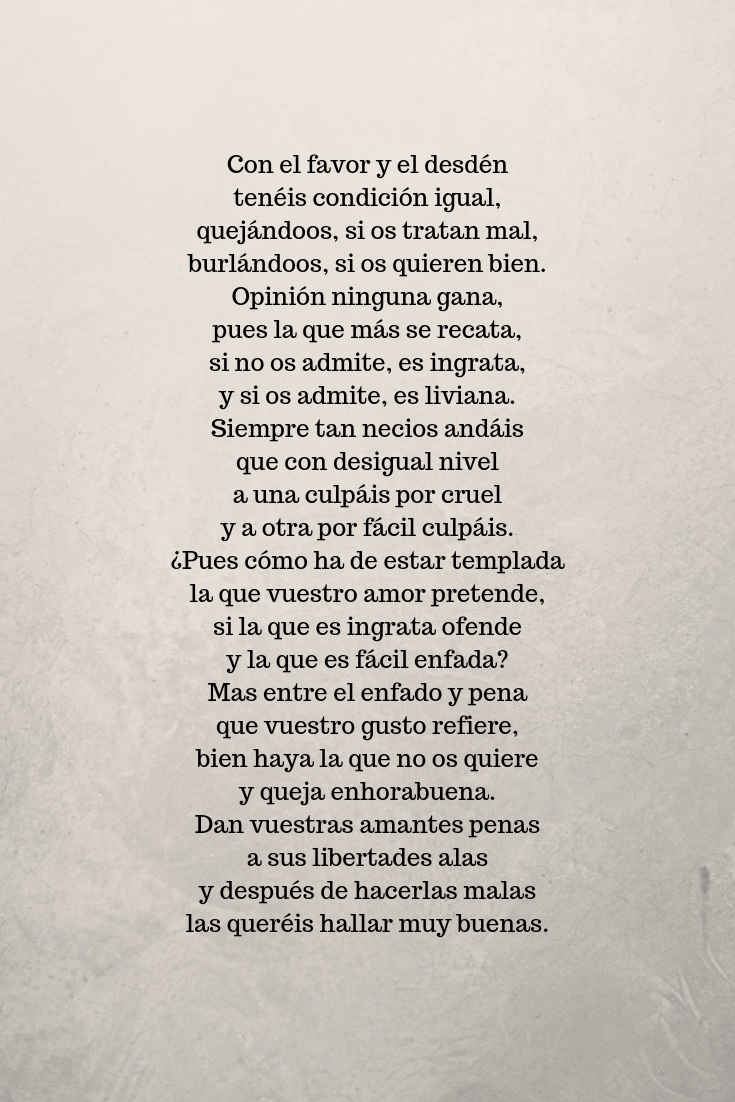
You have to admit, some of her poems are pretty intense. You can find several translations of Sonnet #145 here. You can also find an English translation of Hombre Necios (Foolish Men) here. I don’t think I’m up to the task myself.