Tools That Help Me Write (and Might Help You Too)

You know I’ve been working on my own WIP and Book Marketing Challenges this year, and since we’re all in this together, I thought I’d share a few tools you might find useful in your own writing endeavors. These resources can help you move from idea to done with more clarity and a lot less overwhelm.

🧰 1. The Writer’s Toolkit 2025

Feeling just a little overwhelmed by all the things that come with being a writer today: drafting, editing, publishing, promoting, and social media? 

That’s where The Writer’s Toolkit 2025 from Ultimate Bundles comes in. It’s a curated collection of 22 premium tools, templates, trainings, and courses (worth over $2,300!), created by authors, bloggers, and creatives who get it.

You’ll find resources to help you:

  • Build your author platform
  • Write more confidently and consistently
  • Market your work without burning out
  • Stay organized and focused on what truly matters

Inside you’ll get:
📘 1 eBook
🎥 16 eCourses & Videos
🧾 6 Templates & Printables

It’s only available for one week, so don’t wait!

✨ 2. Oracle Cards for Writers: Unlock Your Story Magic
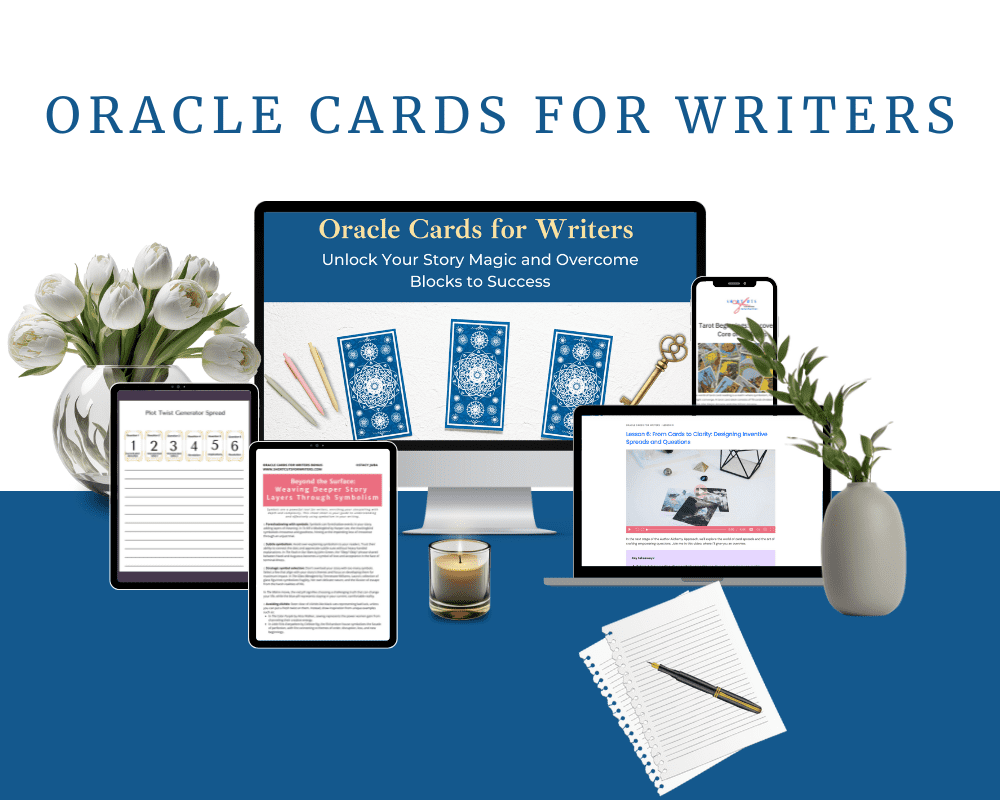
Being an author means conjuring ideas from the unseen, shaping stories from flickers of imagination. Writing is already a mysterious process, so why not embrace that mystery by tapping into your subconscious?

That’s exactly what Oracle Cards for Writers: Unlock Your Story Magic and Overcome Blocks to Success helps you do.

This self-paced online course from my friend Stacy Juba, fiction author and founder of Shortcuts for Writers, invites you to explore 9 richly illustrated lessons filled with journaling prompts, oracle and tarot card spreads for writers, and creative exercises to help you rediscover your flow.

It’s perfect for writers who want to:

  • Create characters that feel real and memorable
  • Add emotional depth and symbolism to their stories
  • Overcome writer’s block and self-doubt
  • Infuse their stories with intuitive insight and meaning

You’ll also receive three exclusive bonuses, including an 18-page eBook on tarot, a symbolism cheat sheet, and a journaling workshop replay ($17 value).

Begin your enchanting writing journey today!

🕒 3. 40 Days to a Finished Book by Leonie Dawson
You know you’ve got a book to write. 

The problem? Writing a book can feel like an impossible task. Too big to start, too hard to keep up with, and too easy to abandon halfway through.

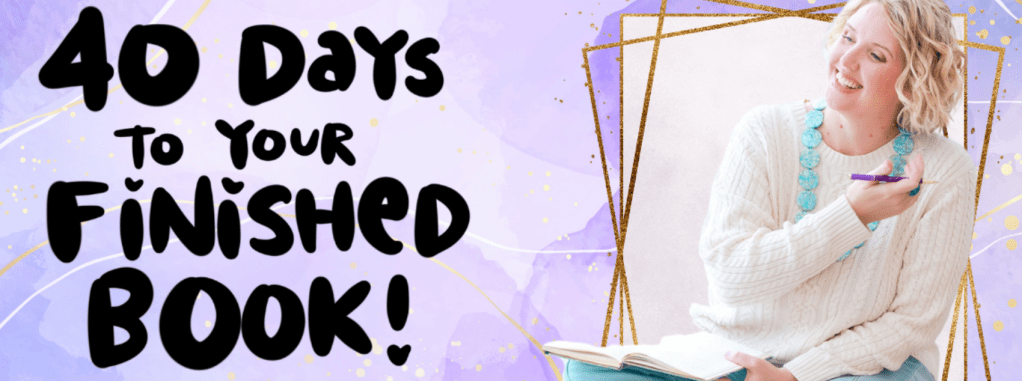
That’s why I love 40 Days to a Finished Book, an online course by creative powerhouse Leonie Dawson. It’s all about guidance, accountability, and fun, with a daily email that includes a writing tip and a request for your word count.

It’s like having an encouraging (and slightly cheeky) writing buddy cheering you on every single day.

If you need structure, support, and momentum to finally finish your book, this might be exactly what you’ve been looking for:

Final Thoughts

Whether you’re building your confidence, finding your voice, or simply trying to make writing a consistent habit, these tools offer structure, support, and a little bit of magic along the way.

Here’s to writing it, finishing it, and sharing it with the world.

The Great Gatsby by F. Scott Fitzgerald

In the spirit of Banned Book Week, I’ve chosen to review a frequently banned book. The Great Gatsby has been challenged and removed from classrooms and library shelves at various times for reasons including sexual references, “profane” language, and depictions of adultery and alcohol use. The novel appears on lists of frequently challenged classics compiled by the American Library Association and related organizations.

This book is like a small, perfectly cut shard of glass: elegant surfaces, sharp edges, and a surprising sting when you look closely. I teach this novel on the platform I work at currently, and the classroom reactions I get have reminded me how much reading is a conversation between text and reader, and how cultural background changes which parts of the book land hard and which parts drift by.

The novel’s canny control of point-of-view, a judgmental Nick Carraway telling us about Gatsby’s dream and the hollowness of old money, is both its strength and, for me, its limitation. Nick’s moralizing gaze gives the book a coherent voice, but it also narrows the novel’s humanity. We almost never see the world except as Nick chooses to frame it. That skewed viewpoint is why the ending, the plot twist, and the moral fallout still hit me every time. The book gives us a climax that feels inevitable and then painfully unresolved.

As a whole, the book can feel thin on action. Much of the “plot” is social maneuvering, parties, and revelations delivered via rumor or later recollection. If you’re the sort of reader who wants kinetic scenes and sustained drama, Gatsby can test your patience. I’m not sure I would have enjoyed it as a teenager. Its pleasures are often retrospective and full of world-weary reflection, things teens don’t always value. My current student, however, is unusually enthusiastic about Gatsby’s romance and tragedy, so who’s to say?

One of my continuing frustrations with the novel is how little we learn about the women who live at its center, Daisy, Jordan, and Myrtle, and even about minor figures like the Finn (the servant) who occupy real positions in the social web. We get Daisy largely as a projection (idealized, then revealed to be small), Jordan as a sketch of modern cynicism, and Myrtle through others’ outrage. Even after reading through the entire book several times, I’m left with questions such as: What were Daisy’s real options in her social world? Why did Jordan cheat and lie, or did she? What did the Finn think about her place in the household and Nick himself? What actually mattered to Myrtle beyond her brief, tragic grasp at glamour? 

In general, I find the sharp, sudden scenes depicting violence to be abrupt and unexpected. The incidents of overt racism and classism are often hard to read from the world’s current position. Despite some definite cringe, I keep teaching The Great Gatsby because it’s compact, richly written, and full of teachable techniques: voice, symbolism (the green light, the Valley of Ashes), and the way an unreliable narrator shapes what a story becomes. It generates excellent class discussions about the American Dream, class, and social performance. But I also teach it with a critique. We read it as a masterpiece and as a text with blind spots, including limited female perspective, a narrow moral lens, and an emphasis on spectacle over sustained action.

If you love it, you’ll find it elegant and quietly devastating. If you find it unsatisfying (as I often do), the book still rewards close reading, especially if you hold a pencil to its margins and ask the questions it leaves unanswered.

The Garden of Small Beginnings by Abbi Waxman

Looking for a feel-good book to read this spring? Then check out The Garden of Small Beginnings by Abbi Waxman.

Lili’s husband was killed in a car accident in front of her house three years ago leaving her with two small daughters. Her sister stepped in to help when Lili had a breakdown. The company that Lili does illustrations for sends Lili to a weekly gardening class as part of the requirements for her next project. The class revolves around turning an empty lot into a flourishing vegetable garden. This is a story of grief, new beginnings, growth, and hope. 

Lili’s efforts at creating a life for her family are a bit irreverent, completely honest, and blessedly hysterical. The chapters are divided by short commentaries about gardening that had me in stitches. Lili finds that life, just as with gardening, provides us with no guarantees of a happy outcome and that’s ok. 

I don’t believe this novel will appeal to everyone, however, being a middle-aged woman who loves gardening and has experienced grief, The Garden of Small Beginnings by Abbi Waxman was right up my alley.

American Dirt by Jeanine Cummins

I’ve read both negative and positive reviews of American Dirt by Jeanine Cummins. The controversy piqued my curiosity and I read the book. After finishing, I have to say that some of the outrage by the Latino community was warranted, but that didn’t make it a horrible read. 

The action begins right from the first page. A shoot-out at a quinceanera barbeque—ok, stop right there. Anyone who knows anything about Mexican culture will tell you that relegating the formal pageantry and coming-of-age ceremony of a quinceanera to a backyard barbeque, with potato salad no less, is sacrilege. 

The cartel, naturally, is the aggressor, the target, a journalist’s family. Since Mexico is one of the most dangerous countries in the world for journalists, the scenario seems plausible. However, describing the shooters as “the modern bogeymen of urban Mexico”, well, the boogeyman isn’t a Mexican creature, but maybe the author meant El Cucuy. 

Mexican currency at the time American Dirt was written.

Lydia and her 8-year old son Luca are the only survivors of the massacre. Knowing she can’t rely on the police, Lydia flees with just a few things she takes from her mother’s house. She pays the hotel’s 4,000 pesos deposit with four pink bills—hold up. The pink bills are each worth 50 pesos each, so she actually pays 200 pesos. The color of money is mentioned again when Lydia needs to pay 10,000 pesos. She lays down 7 pink, 2 orange, and one blue bill, so that would be well, I don’t know. Are we playing Monopoly here because there aren’t any orange bills in Mexican currency?  Maybe the orange ones are the 100 peso bill? 

The head of the cartel that Lydia and her son must hide from is known as La Lechuza, who according to Lydia’s husband could have been the next Bill Gates–really, what’s wrong with a reference to Carlos Slim here? Yes, the criminal leader of the big bad cartel organization is called La Lechuza, just like the popular children’s song, although there is no reference to this song in the story at all. Since the song is about putting people to sleep, it would have certainly added a creep factor if nothing else. 

Lydia comments that La Lechuza is a terrible name since owls aren’t scary. However, it’s common knowledge in Mexico that la lechuza is often a precursor of death, a bad omen, certainly no laughing matter. But again, none of this was mentioned in the book. 

There were more references that just took away from the authenticity, an Italian meal in San Miguel de Allende (not carnitas), ginger ale (not Coca) stored in the Abuela’s basement (who has a basement?), police officers dreaming about pot roast (not tacos), a girl from Honduras looking like an Aztec (not Maya) warrior, the journey measured in miles (not kilometers), using the word vertedero (not basurero), drinking water from the tap (just not done) and so on. 

However, despite it all, I have to admit it was an engaging read. From the get-go I was invested in the outcome, as implausible as some of it seemed. But then again, it was a work of fiction, a fantasy of sorts, so it was ok. Anyway, if you are looking for something that not only provides an exciting adventure but also tests your knowledge of Mexican culture in an alternate universe since it depicts neither an authentic Mexico nor a typical migrant experience, well then American Dirt by Jeanine Cummins is just the ticket. 

Hidden by Lisa Sell

For decades, Jen Taylor believed she had killed her classmate Kelly in an altercation on the railway tracks. An email from Kelly’s mother reawakens all that Jen thought she had buried. Jen reluctantly agrees to look into the matter for the dying mother. This means revisiting her own childhood trauma, something she has attempted to avoid at all costs.

The story leaps back and forth between the present and the past, not necessarily in a linear manner. Clues to what really happened to Kelly are scattered like breadcrumbs throughout the narrative. Even if you think you have it pieced together, odds are you won’t get it just right. I know I didn’t. 

Having experienced the 1980s myself, I enjoyed the attention to detail that the author employed—references to songs, artists, current events, devices, and even clothing styles. Not being British, I also appreciated the cultural explanations, especially at the beginning of the book when describing Rembrandt Estates. 

I had some difficulty keeping track of the children and their parents in parts of the story. I’d have loved a genealogy or even a map of the housing development and its relation to the train tracks to help me keep everyone straight. But then, I’m a visual person. Other people might not have this problem. 
Hidden by Lisa Sell is a mystery you’ll enjoy solving alongside Jen.

For Love and Honor by Jody Hedlund

for love and honor

Sir Bennet finds himself in a bit of a quandary.  His elder brother, Aldric, the Baron of Windsor, has made a mess of the family finances and it’s up to Sir Bennet to make things right.  An arranged marriage with wealthy Lady Sabine might just solve the problem.  Not knowing that she is on her way to meet her potential husband, Lady Sabine believes the reason for the trip to Maidstone Castle is to view the renowned relic collection housed there with the hopes of acquiring a few of the ancient pieces.  Little does she realize that the birthmark she hides beneath her glove will be proof enough to be labeled a witch, endangering her own life and the lives of all who surround her unless she is able to prove her innocence.

This novel is written with teens and young adults in mind.  The story is light and romantic. Lady Sabine are Sir Bennet are likable characters and their interactions during their courtship are entertaining.  The discussion questions that follow the story are designed to help teen girls reflect on their own lives.  This book would make a great addition to units on life in the 1300s, superstitions in medieval Europe and the belief systems of the time.

Although there is no Maidstone Castle in Hampton, where this story takes place, there is a castle near Maidstone which dates to the medieval ages.  The setting adds to the romantic nature of the story.

Set in the middle ages, the accusation of being a witch was a serious matter. A person could be accused of witchcraft for a number of reasons but one of the most common was having a witch’s mark in the form of moles, scars, or birthmarks.  Once accused, innocence could be proven through certain physical trials.

Water-ordeal
By Diebold Schilling the Younger

Three trials are mentioned in the story, although there were many more.  Trial by ordeal, where an accused witch was subjected to some sort of physical punishment.  Rapid healing of the wounds inflicted during the ordeal meant the accused was innocent.  However, if the wound became infected, he or she was guilty.  Trial by dunking was another common test.  The accused would be thrown into a body of water from a boat.  If the accused sank, innocence was the verdict and he or she would be pulled up into the boat.  If the accused floated, it meant he or she had renounced baptism by entering the Devil’s service.  The idea of water being so pure an element that it rejects the guilty originates with Pliney the Elder in his Naturalis Historia, BK VII (AD 70) which states that witches will never drown.

The third trial mentioned in the book was The Lord’s Prayer Test.  The accused is asked to recite the Lord’s Prayer.  If he or she is able to recite the prayer without misspeaking, then the accused would be declared innocent since it was thought that the Devil would not allow one of his servants to do so.

Get your copy here.  Read other reviews of the book here.

3 star

Disclosure of Material Connection: I received this book free from the publisher through the BookLook Bloggers book review bloggers program. I was not required to write a positive review. The opinions I have expressed are my own. I am disclosing this in accordance with the Federal Trade Commission’s 16 CFR, Part 255  “Guides Concerning the Use of Endorsements and Testimonials in Advertising.”

Into Autumn by Larry Landgraf

into autumnInto Autumn by Larry Landgraf

Lars Lindgren is all ready when the grid suddenly goes down in the US.  Years before, he left civilization behind to become a wilderness man on 40 acres of undeveloped land along a small river someplace in Texas.  Shortly after the SHTF, Eileen, stockbroker and small-time gardener, shows up and stays.  Pretty soon, a little self-reliant community springs up including Reggie, with his well-stocked arsenal of weapons, his wife Emily, along with Sam and his wife Sally who raise livestock and children.  It’s becoming a veritable garden of Eden for these hardy folks who regularly pop over for a spot of tea.  Dinner conversations include this year’s projected harvest and the feasibility of blowing up the Tucker family across the highway.

Now, you know I’m all about reading end-of-the-world survival scenarios  It really tickles my funny bone to compare some of those outrageous stories with our actual experience of 10-years off-grid living. So, it will be no surprise to you that Into Autumn by Larry Landgraf gave me a few points to ponder.

The happy valley Lars and Eileen inhabit really is sort of a Prepper utopia.  With the neighbor’s stockpile of weapons and the other neighbor’s animal husbandry setup, Lars doesn’t even have to give up his daily bacon once the world beyond ceases to function. While there was a good overview of the solar panel system and a fair description of the wood stove, there were some aspects that weren’t covered at all, such as waste disposal.  Where did all the poop go?  Septic tank?  Piled in the bushes? Reused as humanure in the garden? (See Jawhole disaster)

How about birth control?  Sam and Sally are still well within childbearing age.  When Lars’ son and Reggie’s daughter get together, they immediately pop out a set of man-twins.  So what stops these obviously fertile couples from breeding like rabbits?  It’s not like there is any TV to watch to while away the evenings.  Apparently, no one thought to bring along the portable DVD player that could have run off the solar panels.  Ok, maybe this isn’t something the male author thought about. However, it is a valid issue.  I know that since moving to an area where birth-control is difficult to obtain (as well as discouraged from the pulpit), I certainly have noticed the rampant crops of babies harvested from the cabbage patch every year.  Why not in this happy valley?  Then again, maybe it would be too hard to keep the toddlers out of the minefield.

There seemed to be an inordinate amount of attention given to listing the essential items that the inhabitants were always running low on.  The list oft-repeated consisted of tea, coffee, salt, and sugar.  Evidently, having these luxuries would keep the little group from becoming animalistic and perhaps converting to cannibals as so happens in the zombie apocalypse scenarios.  I admit that salt is an essential element, but tea and coffee?  If you want a little variety in your beverages, there are oodles of options out there in the wild or easily grown in your own garden. 

I believe Preppers and wanna-be Preppers would enjoy Into Autumn by Larry Landgraf because they could compare their state of preparedness with that of the characters in the book, much as I did.  Those not so concerned about TEOTWAWKI won’t enjoy this book half as much.  

I wasn’t overly impressed with the writing style.  It seemed to be slow and ponderous for the most part. Although there were no grammar or spelling errors, the narration didn’t seem natural.  

3 starRead more about Into Autumn by Larry Landgraf.  This book was an OnlineBookClub.org Book of the Day.  Get your copy here.

When Leaves Fall by C.A. King


Ralph just can’t quite understand how he got to where he is, chained to a rickety shelter, and in pain from random beatings.  His life wasn’t always like this.  He remembers being loved, having regular meals and jumping in the fallen leaves.  As time passes, his despair turns to desperation.  How long is he to suffer?

dog2

When Leaves Fall by C.A. King is a short, young adult novel told through the perspective of an abused canine.  As we’ve had more than our share of doggy family members, the story appealed to me emotionally. 

dog1

Chained, malnourished dogs are a common sight here in Mexico, especially with types of dogs bred for fighting.  In January of 2017, the Mexican Congress passed a law that takes the country one step closer to ensuring this inhumane activity can be penalized throughout the country. (See Mexico says ‘no mas’ to dogfighting) In June of the same year, the law was finally approved. Dog fighting is illegal in Mexico, punishable by up to 5 years in jail and $8,300 USD in fines.  If the offender is a Mexican public official, jail time is increased up to 7.5 years. (See Dog fights as sport now illegal in Mexico

dog3

Although I enjoyed When Leaves Fall by C.A. King, there were a few things that I think the author could have done to add to Ralph’s story.  First, Ralph is never identified by breed, so the reader never gets a clear picture of Ralph.  I understand that the author wanted to be inclusive by implying that this could happen to any type of dog classified as “dangerous” but I felt it detracted from the story. While I was reading, I was jumping back and forth with different dog bodies trying to get a good image of Ralph in my mind. 

Secondly, the section of the book that was not told through Ralph’s eyes didn’t seem realistic to me.  Would a woman return an engagement ring in a courtroom over animal abuse?  Although there are established ties between animal abuse and domestic violence (How Are Animal Abuse and Family Violence Linked? ), statistics show that it takes some time for a woman to leave an abusive relationship permanently. (See Eliminate That Seven Times Statistic, 50 Obstacles to Leaving: 1-10).  Is it realistic to believe that what happened to Ralph was enough to save Syndey and her unborn child from the potentially abusive relationship?

Interestingly, many of Ralph’s thoughts as a victim mirror what the mental process of a human victim of abuse. (See EFFECTS OF DOMESTIC VIOLENCE, DOMESTIC ABUSE (ON WOMEN AND CHILDREN).

3 star

Animal lovers and compassionate young adult readers will enjoy When Leaves Fall by C.A. King.  As the writing is somewhat simplistic in an effort to present the situation through the dog’s eyes, this book might not appeal to everyone.

Read more about this book here.  This book was an OnlineBookClub.org Book of the Day.

the hideaway by Lauren K. Denton

the hideaway

Sara Margaret Jenkins has just inherited her grandmother’s dilapidated bed and breakfast in Sweet Bay, Alabama.  Forced to leave behind her New Orlean’s business to attend to the numerous details, she discovers a bit of mystery surrounding her grandmother Mags.  Sara has a chance at a new life in Sweet Bay if she can find the strength to stay.  After all, not all stories end happily ever after.

The Hideaway by Lauren K. Denton is a romantic novel about new beginnings.  The story is told in overlapping chapters, past, and present, grandmother and granddaughter. Even though the book begins with Mags’ death, her story is told through her own eyes as Sara pieces together the clues left.

I enjoyed both stories although perhaps Mags story just a wee bit more.  Her in life in the 1960s, with its expectations and issues, was masterly crafted.  The characters that arrived and stayed or left in The Hideaway were diverse and interesting.  It would be a real treat to hear William, Dot, Mrs. DeBerry, Daisy, Starla, Glory, Major, Bert, and even Robert’s stories as well.

One issue I was a little confused about was the ownership of the house.  Originally, the bed and breakfast was run by Mrs. DeBerry who leaves the business in dire financial straits.  Legally, how did Mags obtain the title?  Then just how exactly does the town of Sweet Bay use eminent domain when the legitimate owner has due process rights?  Of course, knowing the details isn’t essential to enjoying the story but it would add an additional element of realism.
The Hideaway by  Lauren K. Denton is a delightful light read.  You won’t be disappointed with this one!

four star

Disclosure of Material Connection: I received this book free from the publisher through the BookLook Bloggers book review bloggers program. I was not required to write a positive review. The opinions I have expressed are my own. I am disclosing this in accordance with the Federal Trade Commission’s 16 CFR, Part 255  “Guides Concerning the Use of Endorsements and Testimonials in Advertising.”