Blog to Book Project — Book Launch

Back in the day of traditional publishing, a successful book launch was essential for an author. The publicity surrounding the launch of a book would not be funded by the publishing company again if the initial launch flopped. Books that were not sold within a period of time would be bundled and discarded. 

With the rise of self-publishing, and print-on-demand services, the question of what to do with unsold books is no longer an issue. Book files can slumber peacefully in the Amazon cloud until they are awakened and downloaded. Although book launches are still great marketing strategies, authors have shifted their attention to year-round publicity and the production of new works rather than putting all their eggs in one basket in a lavish book launch. 

Some authors hope that the added noteriarty generated in a book launch will propel their book to the best seller list on Amazon, which in turn ensures Amazon will do more to promote the book, leading to even more book sales. A book launch certainly can do that, but chances are low. So don’t get too discouraged if your book doesn’t skyrocket to the top during your book launch. Remember, slow and steady wins the race.

By definition, a book launch is the combined activities surrounding the release date of your book. Most of these activities will center around marketing and can occur before or after the official day the book is available to the public. 

Pre-release

Before your book is out there, you might do some interviews, podcasts or guest posts on other sites. While the topics discussed may not be directly related to your book, odds are that you’ll have ample time to mention and encourage readers or listeners to be on the lookout for your new tome. 

Starting the hype on your own author website and social media should also be parts of the pre-release book launch activities. Add a countdown graphic. Talk about how excited you are. Mix in a few testimonials from Beta readers. Make your readers want to get their hands on your book the moment it is ready.

Release Day

Host a book party! Hang out with your friends with signed author copies of your books and celebrate your accomplishment. It’s not every day that you publish a book! Consider a themed party. Have guests come as characters in your novel. Make sure to get plenty of pictures that you will then use in your next post on your author website and upload to social media. 

If you aren’t able to host a live book party, then consider a virtual one. Go live on Facebook at a specific time. Let fans know you’ll be available to answer questions. Offer book giveaways for those who drop by or share your information. 

Post-release 

The period after your book has been released is no time to rest on your laurels. Get busy marketing. Do more interviews, podcasts and guest blogger posts. Set up a Countdown Deal or Free Book giveaway and let EVERYONE know about it. 

Begin to create an author brand. What genres will you be known for? What can readers expect from your future books? What is the next book about? This is the time to start generating interest for your following publication. Set up an option for pre-orders or release day notifications. 

Consider a book signing tour to keep the momentum going. Of course, since you are self-publishing, then you’ll need to foot the bill for this yourself, so it may not be practical. 

A better alternative might be to ask local libraries if they’d like to have a copy of your book for their shelves. Announce your book’s library inclusion from the rooftops of social media. 

Keep adding interesting and relevant information to your author’s website, interspersed with reminders that your book is available for purchase. Get busy on that next release and repeat the cycle. 

Assignment: Plan your book launch activities. 

Blog to Book Project — Amazon Affiliates Program

I’ve been an Amazon Affiliate since I started blogging. I don’t make oodles of money, but I do make a little bit. If you haven’t already signed up, then you should do so. You have set up your blog and started creating a social media presence right?

Basically, you can get a tracking code for any product page on Amazon. If someone clicks on your link, Amazon knows about it. You may be eligible for a commission on anything they purchase after they click that link, even if it wasn’t the product that originally led them to Amazon. 

There are all sorts of tools designed to drive traffic from your link to Amazon that the company provides. You’ll need to decide which will work best for you. 

However, as an author, being an Amazon Affiliate means that you get a small commission on your own book in addition to royalties if someone buys your book using your affiliate link. A bit of double-dipping, shall we say! 

Being an Amazon Affiliate also provides you access to the Kindle Instant Preview links which we will talk about in a bit. Plus, when you offer your Free Book Promotion, if readers downloading your book stay on Amazon and purchase something else, you’ll get a commission there too. 

The important thing is not to abuse your affiliate status. Amazon does not allow affiliate links in ebooks sold on Amazon, so make sure your book doesn’t have any. You also must not click on your own links to generate commissions. Amazon will boot you out of their program if they catch you. 

And you’ll need to disclose your affiliate relationship with Amazon in posts, newsletters and other places you may insert a link. I use an image on my blog’s sidebar that is visible on whatever page is being viewed. 

The easiest way to get affiliate links for your book is to go to the book’s detail page on Amazon. You’ll have three options, text, image and text plus image. Feel free to try them all and see what gives you the best results. 

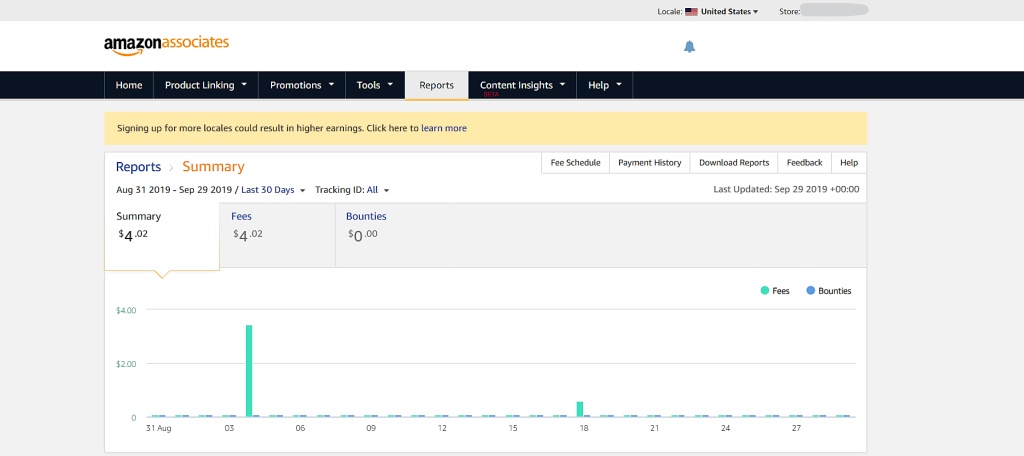
You can keep track of clicks and commissions earned from the Earnings section on your Amazon Associates SiteStrip that will now appear at the top of any page you visit on Amazon. 

You can also see how many ebooks your links have sold, whether yours or another author you are promoting. There’s no need to be stingy with Amazon Affiliate links. The more the merrier. 

Amazon pays out commissions earned every two months. You need to meet a minimum amount, otherwise, the amount just rolls over until you meet the minimum. If you choose to get paid by direct deposit or Amazon gift card, you’ll get paid after your commissions earned a total of $10. If you want to receive a check, then you’ll need to wait until you rack up $100.

So that’s a brief overview of the benefits of becoming an Amazon Affiliate as an author.

Assignment: Sign up to be an Amazon Affiliate

Queen of America by Luis Alberto Urrea

Queen of America by Luis Alberto Urrea is the second half of the life of Teresita Urrea, the Saint of Cabora, so imaginatively told in The Hummingbird’s Daughter. Forced to leave her home in Mexico, she begins a new life in Arizona in 1892. 

Things aren’t easy for Teresita. Endless petitions for healing, unscrupulous business conglomerates running the show, and a husband that tries to murder her on their wedding night. Somehow, she manages not just to get by but thrives in the turn-of-the century New York world that clamors for her attentions. 

While I was fascinated with the story of the girl who inspired a revolution, I didn’t find the second installment as interesting to read as her childhood in Mexico had been. Perhaps because there were more documented facts about her life in the US from newspaper clippings and interviews, the author didn’t let his imagination take wing as he had when writing about her youth. That’s not to say it wasn’t an enjoyable read, just not as good as The Hummingbird’s Daughter.

The title confused me somewhat since the only reference to the Queen of America in reference to a servant in the Urrea household. However, in a commentary by the author, he indicated that he wanted a title that had the same number of syllables as The Hummingbird’s Daughter. He also made an allusion to one of the titles of Mary, Queen of the Americas, although I think he would have done better to choose a name from the titles granted to la Virgen de Guadalupe such as Queen of Mexico and Empress of the Americas. After all, she was indigenous and often credited with miraculous healings in Mexico, just as Teresita was.

Regardless of where the title comes from, Queen of America is an interesting read, especially if you were captivated by this little Yaqui girl’s story from the onset.

Blog to Book Project — Twitter for Authors

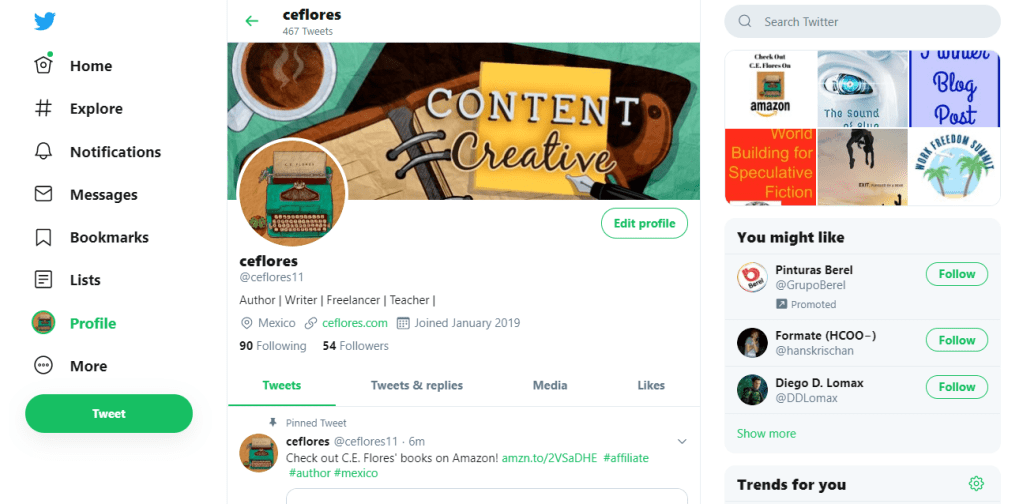
Twitter is another great place to advertise. When you sign up for Twitter you get to choose your user name. You can choose your own name, a pen name or something really cool.  If the name you want to use is taken, which happens a lot, come up with something else. 

Fill out the profile information completely. Make sure to include a link to your author website. Add your profile picture. I use my page icon instead of my author picture, but that’s just me. If you are having difficulty deciding what to include on your profile, look at other authors in your genre and see what they have done. 

Take some time every week or so to find other writers, book reviewers, and interesting people to follow. Try to find people that are prominent in your particulate niche. 

Tweet a variety of images, posts, links, book reviews, author interviews, news articles along with a few self-promotional bits. When your stuff gets retweets or comments, publicly thank them. It’s good form. 

Use hashtags generously.  #bookreview #author #freebookpromo #freekindle 

The lists option is a nice way to organize the people you follow. They get a notification that you put them on a list and are often flattered enough to follow you back. 

Twitter is a rapid-fire social media site. Tweet copiously!

Assignment: Set up your Twitter account and begin tweeting!

Learn to Love: Guide to Healing Your Disappointing Love Life by Thomas Jordan, Ph.D.

It was obvious that Learn to Love: Guide to Healing Your Disappointing Love Life was written by a researcher. The book begins by explaining what book will cover. Then the book discusses those points, one by one. Finally, the conclusion recaps the information, exactly as if it were a research paper. 

While I personally felt that the section on what will be covered in the book was unnecessary, the rest of the book was well-presented. Appropriate citations were included throughout the book to reinforce the main points. The author also used his own love story to make the message personal. When I finished the book, I felt like I had attended a “love relationship class”, which I believe was the author’s intent all along.

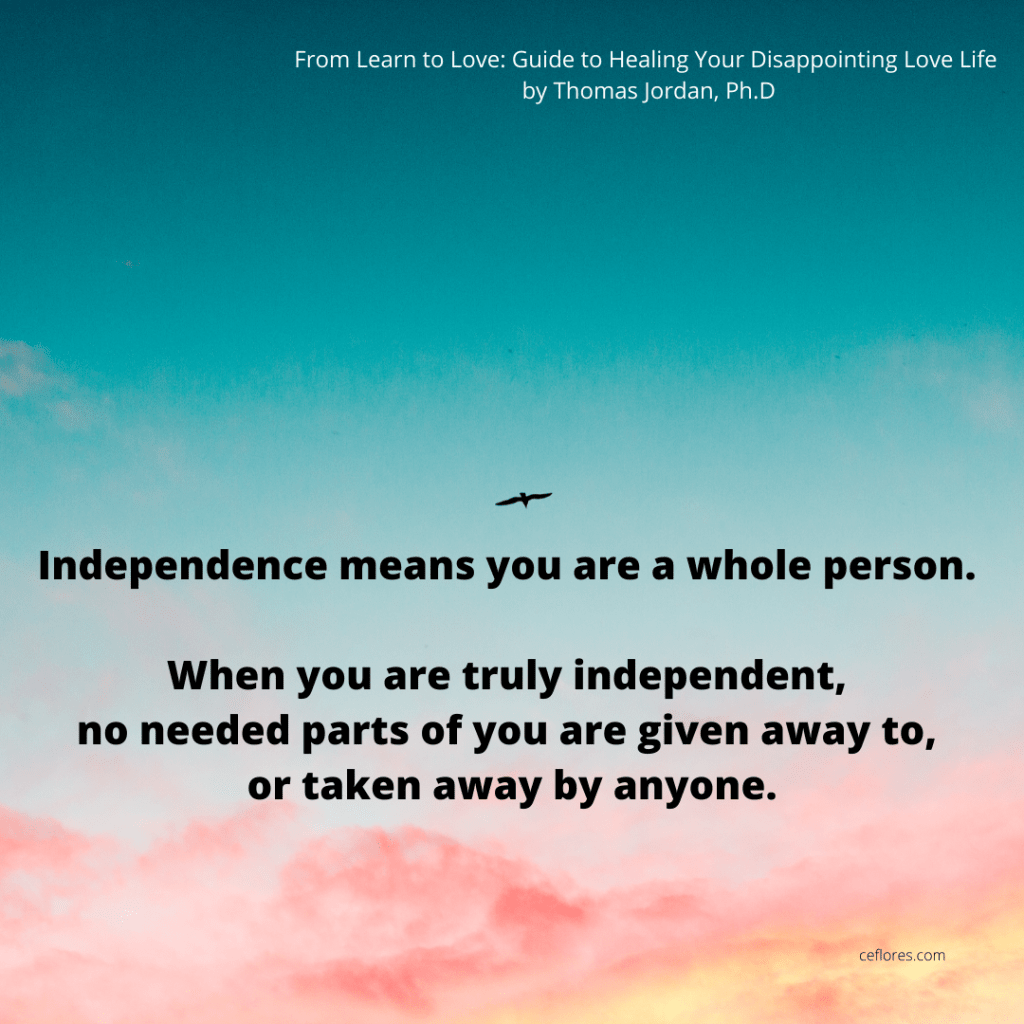
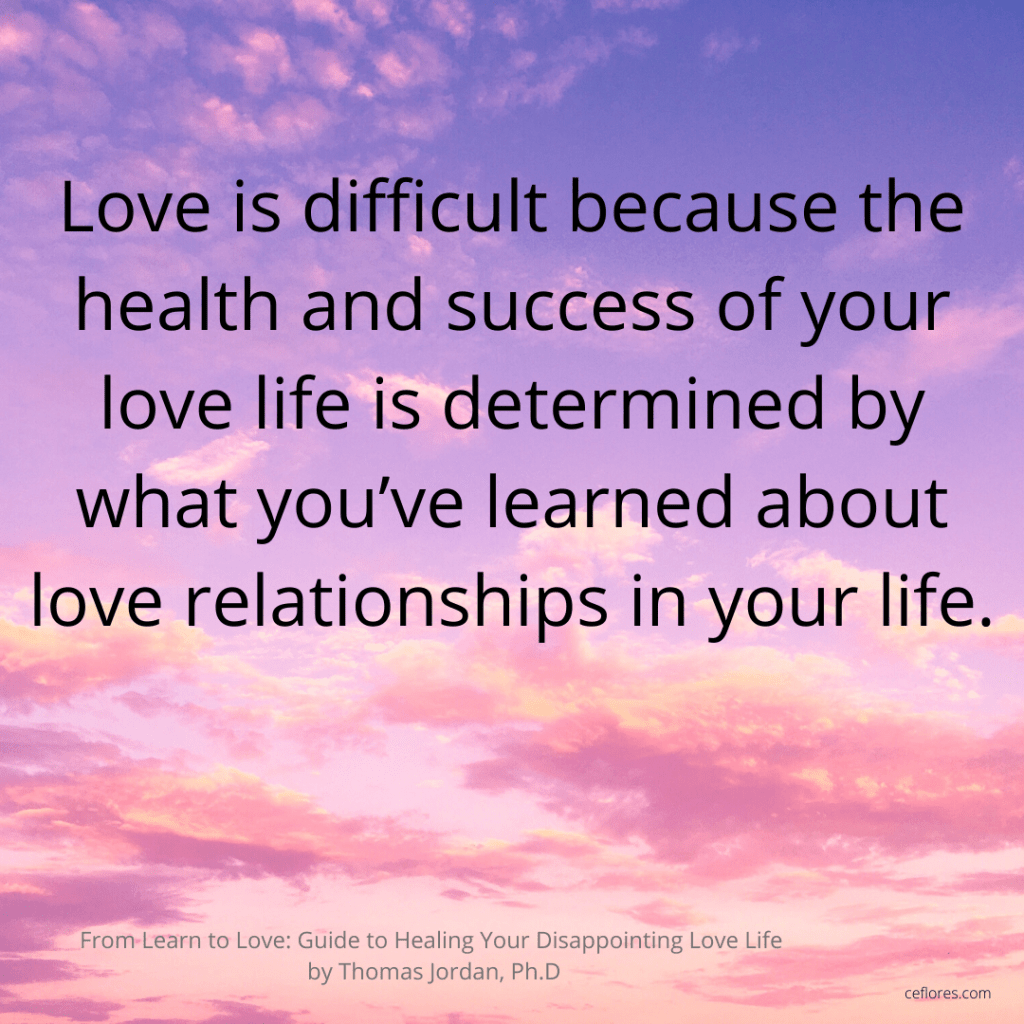
So what did Dr. Jordan have to say about love relationships? In a nutshell, our relationship choices are often based on the types of relationships we had in our family of origin. It’s likely that a person who was abused as a child, will find a way to become an abuser or take on the role of victim in his or her romantic relationships.

This recreation of past hurts isn’t really a new concept. However, Dr. Jordan takes the idea a step further and proposes that once we realize this, we can change it. The types of unhealthy relationships are discussed as are their healthy counterparts. There are questions to help you determine what types of interactions you are repeating so that you can work towards finding healthy and whole love relationships. 

The material is simply and clearly presented in terms that everyone can understand. In conclusion, I feel that Learn to Love: Guide to Healing Your Disappointing Love Life by Thomas Jordan, Ph.D. is a book that should be read by those in a relationship, those looking for a relationship, and those who have ended a relationship.

I received an advance review copy from Reedsy Discovery. You can read my review here.

Blog to Book Project — Proof Copies

Proof copies are great to send Beta readers, proofreaders, copy editors or to do a final check yourself. A proof copy is what your book would look like before it gets the final quality review at Amazon. 

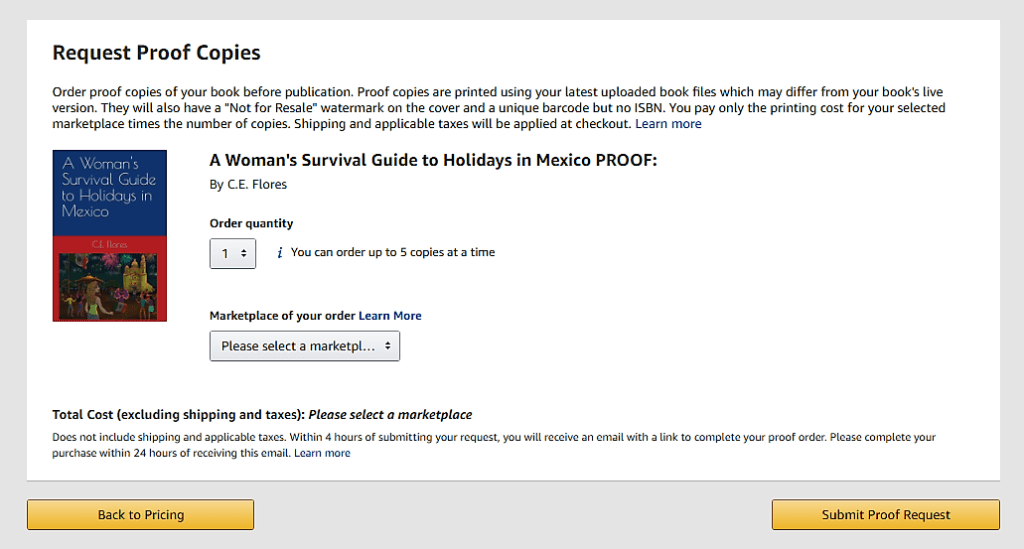
You can only order proof copies when your book is in the draft category. You will get the opportunity to order proofs when you reach the Paperback Rights & Pricing tab in the uploading process. Click on the link in the box above the yellow Publish Your Paperback Book button that says “Request Printed Proofs of this book that you can order from the Amazon cart.” 

Clicking on that link will take you to a page where you can place your order. You can order up to five copies at a time. You can ship to multiple addresses by placing separate orders.

After you order your proof, you can publish your book immediately or wait until you’ve had a chance to look over your book. Remember, if you do find errors, you can upload a new manuscript with corrections. 

You will receive an email from Amazon KDP with a link to complete the order for your proofs. You must complete the transaction within 24 hours of receiving the email, otherwise you’ll have to make the request again. 

Proofs are a little different from regular copies of the book. Across the cover there is a “Not for Resale” watermark and no ISBN although there is a bar code. Other than that, the text and image formatting is the same, so if there is something that you want to change after seeing your book in print, do it.

Assignment: Order your proof copy.

Authors’ Revolution Workbook by B. Alan Bourgeois

Unbelievably, I did it again. I choose a workbook to review without having read the main book that the workbook as a companion for. This time I chose Authors’ Revolution Workbook by B. Alan Bourgeois and had high hopes. After all, I am a self-published author myself and am always on the lookout for tips. 

My reaction towards this book was mixed. There were excellent bits of information for authors that help them look at the publishing dream reaslitistically. The graphics were also very useful as visual representations of that reality. The Cost of Publishing Worksheets were worthwhile additions. Using them, an author could compare his or her costs to the average amounts spent by authors in the creation, publishing and marketing areas. Becoming a successful published author isn’t an overnight event as the uninitiated might believe. 

The companies and organizations that were listed under different headings were also practical resources. Each company or feature was classified by average price and services offered. There were listings for places to have your book reviewed, marketing and publishing companies, and useful social media tools. There was even a section on companies to avoid. 

You may ask, with all these beneficial guides included, why have I not given this a five-star rating? That’s a fair question. Yes, the workbook contained great resources for authors. However, I didn’t feel that it was enough for the workbook to stand on its own. In fact, the workbook would have done better to be included as an appendix in the main book. 

There was also inconsistent capitalization throughout the text, as if headings had been copied and pasted from another source. Then there were an overwhelming number of blank pages. There were no exercises to complete or self-reflective questions to respond to as might be expected in a workbook with lots of space to respond. In fact, the only work in this workbook were the The Cost of Publishing Worksheets and a question about your book’s launch date.

Finally, there was a second author bio included at the end of the book. The first bio was shorter and placed at the beginning of the workbook so readers had a general idea who the author was and why he was qualified to bring us this workbook. However, a second author bio which said pretty much the same thing was really unnecessary. 

So even though I found much of the information in Authors’ Revolution Workbook by B. Alan Bourgeois useful, I find myself unable to justify its existence apart from the main book, which I have not read.  

I received an advance review copy from Reedsy Discovery. You can read my review here.

A to Z Challenge Theme Reveal 2020

This year for the A to Z Challenge, Content Creative will continue to share information about how to set up and self-publish your book on Amazon. The process doesn’t have to be shrouded in confusion, as many book publishing companies make it seem. However, you, as the author and publisher, are responsible for creating the best literary work possible and it can be tricky.

Images, book covers, formatting, editing, book order, uploading to Amazon, and marketing are key components to creating an incredible book that you can be proud of. Look for these topics and more in the month of April as part of the 2020 A to Z Challenge.

Blog to Book Project — Author Copies

Author copies are copies of a book that are given to the author at the time of publication by the publisher. If you aren’t going the traditional route, you can still get author copies of your blog to book project and you should!

With Amazon Kindle Direct, for example, you can order up to 999 copies of your book for only the cost of printing, which depending on your final book price, can be a substantial saving.

Author copies make great marketing tools. You can donate them to your local library. You can sign them and make them prizes in raffles or giveaways. You can send them to family and friends. You can give them to all those people you thanked in your acknowledgment section. Send them to people who want to review your book. You can sell them yourself, but you won’t get royalty payments on them.

Plus, a shelf of your own blog to book projects in print form makes a heart glad!

To order Author copies, go to your KDP Bookshelf and choose the book you want to get copies of. Next, enter the number of copies you would like and pick the marketplace through which you’d like to order the books. To save on shipping costs, choose the Amazon branch closest to your shipping address. 

Assignment: Order some Author copies.